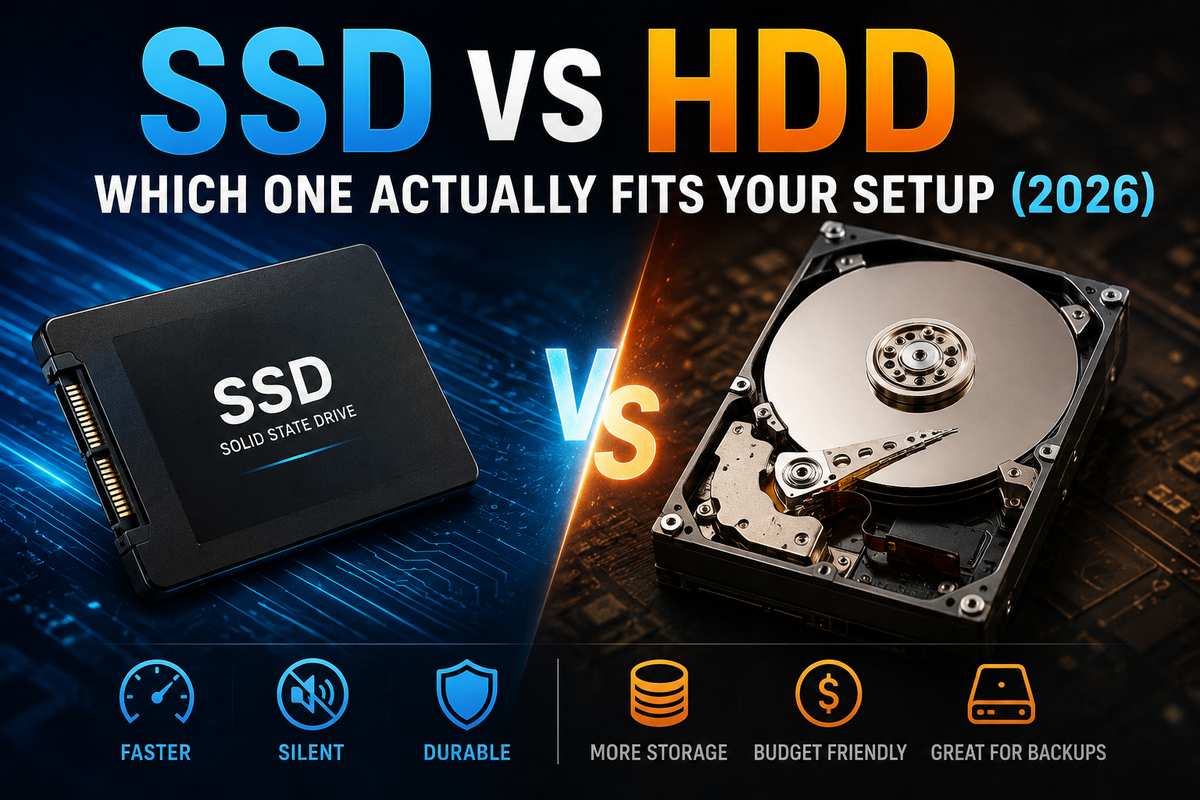

This is probably the most asked storage question there is, and it still doesn’t have one clean answer. SSD vs HDD isn’t really a competition anymore. Both technologies serve different jobs well. The real skill is knowing which job you’re actually trying to solve for.
We’ve covered internal SSDs and internal hard drives separately already. This piece exists to put them side by side directly.
Speed: Not Even Close
Ssd or hdd for pc speed comparisons aren’t subtle. A decent SATA SSD boots Windows in 10-15 seconds. A mechanical drive doing the same job takes 30-45 seconds, sometimes longer on an aging drive. NVMe SSDs widen that gap even further. Application load times that take 8-10 seconds on HDD often complete in 1-2 seconds on NVMe instead.
Hdd vs ssd for gaming specifically shows up as level load times, texture streaming, and open-world pop-in. Games built around fast storage, anything shipped in the last few years really, noticeably stutter on a mechanical drive. An SSD simply doesn’t have that problem. This gap is exactly why most people put their OS and active games on SSD regardless of budget constraints elsewhere in the build.
Price Per Terabyte: HDD Still Wins
This is where hard drives earn their keep. A 4TB HDD costs a fraction of a 4TB SSD. That gap holds true across nearly every capacity tier once you’re past 1TB. For bulk storage, backups, and archives, that price gap matters more than the speed difference does, since you’re not opening those files constantly anyway.
External hard drive vs ssd comparisons follow the same logic in portable form. An external HDD costs meaningfully less per terabyte than an external SSD at the same capacity. External SSDs have gotten more competitive recently, though, especially at lower capacities under 2TB, where the price gap has narrowed considerably over the past year or two.
Reliability: Different Failure Patterns, Not Necessarily Better or Worse
SSDs have no moving parts, so they’re immune to the mechanical failures that eventually kill hard drives. No more clicking noises, no dropped platters. But SSDs wear out through write cycles instead, tracked via a spec called TBW. Under normal consumer use, that wear rarely becomes a real issue within a drive’s practical lifespan.
HDDs fail differently and often give warning signs first. Unusual noises, slower response times, and SMART errors flagged by your OS before a full failure hits. SSDs can fail more suddenly, occasionally with no warning at all. Neither technology is inherently more reliable across the board. They just fail in different, predictable ways, and either one storing anything irreplaceable needs a backup regardless of which you pick.
Power Consumption and Heat
SSDs draw noticeably less power than HDDs, particularly under sustained heavy use. They produce less heat as a direct result too. This matters more in laptops than desktops, since lower power draw translates fairly directly into meaningfully better battery life on a laptop running an SSD versus an equivalent HDD.
In desktops, the power difference is real but rarely decisive on its own. It’s a nice bonus rather than a primary reason to choose one over the other. Unless you’re specifically building something power-constrained, like a compact NAS or a silent, low-power home server setup, where every watt saved genuinely matters.
Noise: A Genuinely Underrated Factor
SSDs are completely silent, no moving parts means literally nothing to hear. HDDs produce audible spinning and occasional clicking during read and write operations. In a quiet room that noise is genuinely noticeable, especially at night or in a home office setup where ambient noise is otherwise low.
For anyone building a media center PC or working in a quiet space regularly, this factor alone pushes plenty of people toward SSD. Even in situations where the price difference would otherwise favor HDD on pure economics alone.
Lifespan in Practice
Marketing numbers on both sides tend to overstate real-world lifespan in either direction. A consumer SSD under typical use, browsing, gaming, and general productivity easily lasts 5-10 years before write wear becomes a genuine concern. A well-made HDD under similar light-to-moderate use often lasts just as long, sometimes longer, provided it isn’t dropped or subjected to constant vibration.
Where the two diverge is under heavy write workloads specifically. Constant large file writes, video editing scratch disks, and server-style usage, that kind of load wears an SSD’s NAND faster and stresses an HDD’s mechanical components harder too. Neither drive type magically becomes bulletproof under abuse, and matching the drive to the actual workload matters more than any single lifespan number printed on a spec sheet.
Health Checking: Don’t Skip This Regardless of Which You Choose
Whichever you choose, monitoring drive health matters. Our SSD health guide covers checking wear level and remaining lifespan on SSDs specifically. HDDs benefit from SMART monitoring tools that watch for the early warning signs mentioned above. Reallocated sectors, rising temperatures, and increasing read error rates, all of it typically shows up well before an actual failure happens.
Neither drive type is maintenance-free. Both benefit from periodic health checks, especially if the drive is storing anything you genuinely can’t afford to lose without a backup elsewhere.
The Realistic Answer: Use Both
According to Crucial’s storage comparison, most modern PC builds benefit from exactly this hybrid approach rather than picking one technology exclusively. SSD for your operating system and actively used applications or games. HDD for bulk media, backups, and archives you’re not opening every day. This isn’t really a compromise, it’s genuinely the optimal setup for the vast majority of people, balancing speed where it actually matters against cost where raw capacity matters more.
Final Thoughts
Ssd vs hdd stopped being a real rivalry once prices settled into their current lanes. Use an SSD for anything you interact with regularly, your OS, your games, and your active projects. Use an HDD for anything you’re storing rather than actively using it day to day. Most builds benefit from both working together rather than picking a side entirely, and that combination gets you the best of what each technology actually does well.