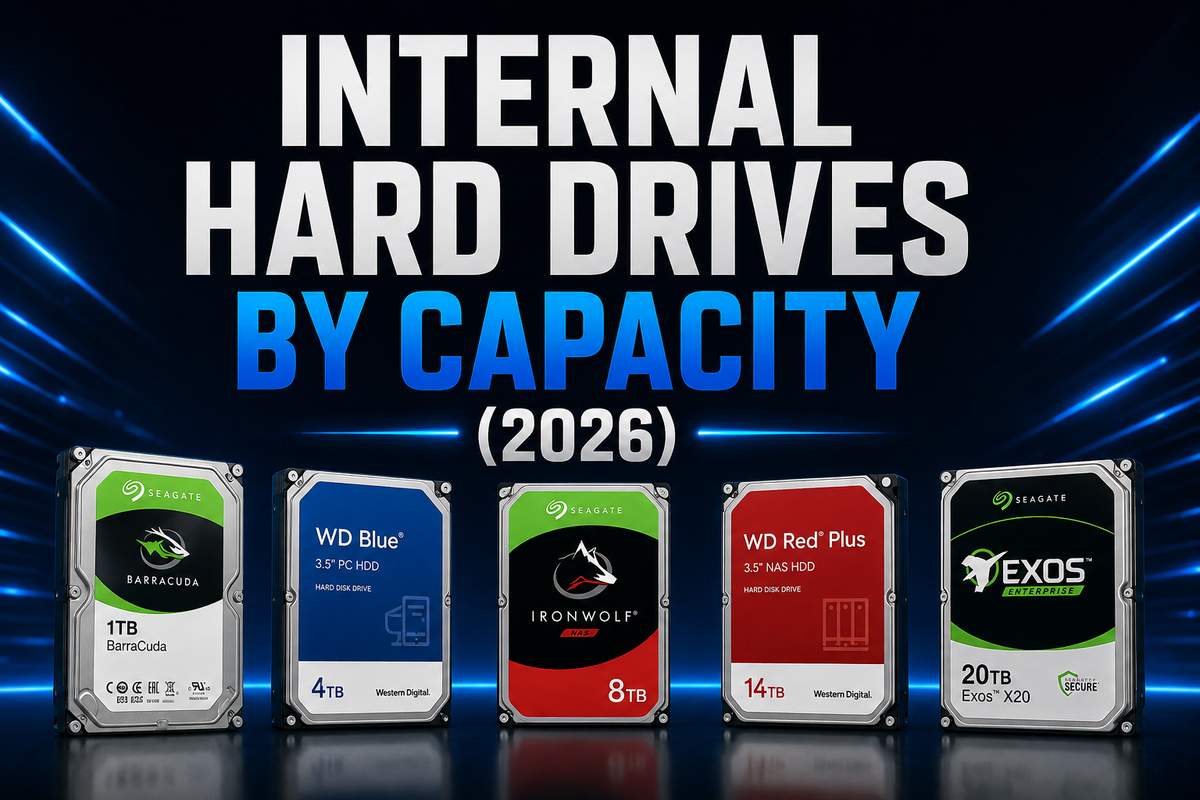

SSDs get all the attention these days, and fair enough, they’re faster. But mechanical hard drives haven’t gone anywhere. For a lot of use cases, they’re still the smarter buy. Cheaper per terabyte, by a wide margin, and that gap hasn’t closed the way people assumed it eventually would.
If you’re trying to decide between an SSD and an HDD for a specific drive slot, our SSD buying guide covers the other half of that decision.
Why HDDs Still Make Sense in 2026
A 4tb hard drive costs a fraction of what an equivalent SSD runs. For bulk storage, that math still wins, easily. Sata hard drive pricing has barely budged in real terms over the past couple years. Meanwhile, SSD prices actually crept back up recently, thanks to NAND shortages tied to AI demand. Weird timing, but here we are.
The honest use case for an internal HDD in 2026 is anything that doesn’t need speed. Game and OS drives, sure, put those on SSD. But bulk media, backups, archives, anything you’re not opening constantly, and an hdd sata setup handle that just fine. Saves real money doing it too. If you’re storing game libraries specifically for a console rather than a PC, our console storage guide covers how internal HDD logic differs there.
Capacity Tiers That Actually Make Sense
4tb hdd and 4-terabyte hard drive options sit at the entry point most people land on. Handles a solid media library, general backups, and more than enough for casual use. Hd 4tb pricing usually comes in under $100 these days. Honestly kind of wild given what 4TB used to cost just a few years back.
An 8TB hard drive and 8tb hdd capacity double that headroom without doubling the price. Price per terabyte actually improves here, which is always nice to see. Hdd 8tb drives are where a lot of enthusiasts land. Big enough for a serious game backup library or years of photo and video archives, without thinking twice about space.
12tb hard drive territory is where things get more specialized. Makes sense for NAS setups, home servers, or anyone archiving large video projects long-term. 5tb hard drive and 5TB hard drive capacities exist too, sitting in an odd middle spot. Honestly less common than 4TB or 8TB. Worth checking whether the price actually beats a 4TB or 6TB alternative before assuming 5TB is the smart middle ground, sometimes it isn’t.
SATA Is Still the Standard Here
A SATA hard drive and an SATA HDD point to the same thing. Both terms lead you to that same standard interface, unchanged for two decades now, with zero signs of that changing anytime soon. Sata drive connections max out around 600 MB/s in theory. Real HDDs never get close to that ceiling anyway, though, since the mechanical drive itself is always the bottleneck, not the interface it’s plugged into.
A 3.5-inch hard drive is the standard desktop form factor. It’s what you’ll find in almost every internal HDD above 2TB, no exceptions worth mentioning. Laptops mostly moved to SSDs entirely at this point. So 3.5 hard drive units are really a desktop and NAS thing now, not something you’re shopping for in a laptop upgrade anymore.
Hdd and sata questions come up a lot from people confused about compatibility. Any modern motherboard has SATA ports built in. Compatibility isn’t really the issue here, it’s more about whether you’ve got enough ports and drive bays for what you’re actually trying to install.
RPM and Cache: What Actually Matters
Most consumer HDDs spin at either 5400 or 7200 RPM, and the difference is bigger than the numbers suggest. 7200 RPM drives outperform 5400 RPM models by roughly 20-30% in real-world transfers. Matters if you’re moving large files regularly. 5400 RPM drives run quieter and cooler, though. Worth something if the drive lives somewhere you can actually hear it running.
Cache size matters more than people expect too. A drive with 256MB of cache handles sustained transfers noticeably better than one with 64MB. Especially with big sequential files like video projects. It’s a spec that gets buried in the listing half the time, but it’s worth checking before you buy on price alone.
CMR vs SMR: The Spec Nobody Explains
This one trips people up constantly, and it’s not clearly labeled half the time, which doesn’t help. CMR, conventional magnetic recording, is the traditional way HDDs write data. Performs consistently regardless of workload. SMR, shingled magnetic recording, overlaps data tracks to pack more capacity into the same physical space. Sounds great until you hit sustained heavy writes, then performance falls off a cliff.
Budget drives at lower capacities are where SMR shows up most. Manufacturers don’t always advertise it clearly either, which is genuinely annoying. If you’re using the drive for straightforward backup or archival storage, SMR is fine, no real downside there. If you’re doing constant large file transfers or running it as active storage, check the spec sheet or search the model number before buying. CMR is worth the small premium in that case. This same SMR versus CMR distinction applies to external hard drives too, not just internal ones, so it’s worth checking regardless of which you’re buying.
Drive Failure and Backup Habits
Mechanical drives fail differently than SSDs, and it’s worth understanding before you rely on one for anything important. HDDs have moving parts, a spinning platter and a read head, and those parts wear mechanically over years of use. Failure often comes with warning signs too, unusual clicking noises, slower response times, or SMART errors flagged by your operating system.
That’s actually an advantage over SSDs in one specific way. SSDs can fail suddenly with zero warning, while HDDs often give you a heads-up before they go. Backblaze’s annual drive reliability reports back this up with real failure data across tens of thousands of drives in active use, worth a browse if you want numbers instead of anecdotes. Either way, an internal HDD storing anything you can’t afford to lose needs a backup plan, full stop. A second drive, cloud backup, or whatever works, just don’t treat any single mechanical drive as permanent storage.
Final Thoughts
Internal hard drives aren’t going away anytime soon, not with SSD prices doing what they’re doing right now. Match your capacity to actual use. 4TB and 8TB cover most people, 12TB and up is for serious archiving or NAS builds. Check RPM, cache, and CMR versus SMR before buying on price alone, those specs matter more than the capacity number by itself. According to Tom’s Hardware’s hard drive testing, dollars per terabyte remains the metric that actually matters here. Not brand loyalty, not marketing claims about speed a mechanical drive was never going to deliver anyway.