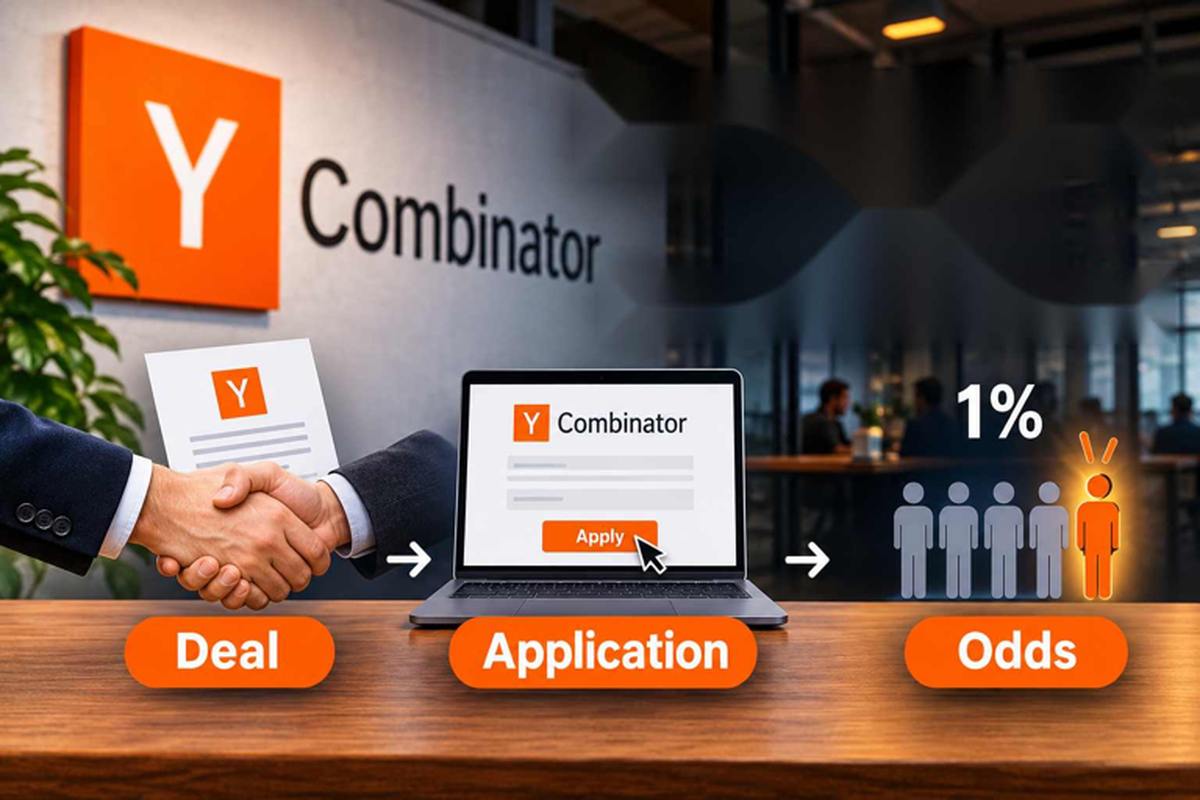
AI-generated illustration
Y Combinator, or YC for short, is the startup accelerator most founders have heard of and very few get into. It puts money into early companies, runs them through a short program, then pushes them toward investors. Honestly, the brand does half the work.
I have never applied. So treat this as an outside read, built on YC’s own pages and news coverage. Here’s the thing: the deal is simple, the odds are steep, and the free resources are better than most people realize.
What is Y Combinator?
Y Combinator is a startup accelerator founded in 2005 that takes equity in early-stage companies in return for funding. If you wondered what YC means or want the YC definition, it’s just the short name. Not an acronym for anything else here.
Alumni include Airbnb, Stripe, Dropbox, DoorDash and Coinbase. That list is why the YC logo, a white Y on an orange square, makes investors sit up. Still deciding whether to build a company at all? Our startup founder’s guide is a decent place to start.
Sure, plenty of great companies never touched YC. But the network and the credibility are real. It just isn’t the only path, and I think people forget that.
What does the YC deal include?
The standard YC deal is $500,000, split into two SAFEs. The first is $125,000 on a post-money SAFE for 7 percent of the company. The second is $375,000 on an uncapped SAFE with a Most Favored Nation provision. YC also keeps a pro rata right to invest in later rounds.
YC says it charges no fees and ties nothing to milestones. It commits when it accepts a company, not when the batch starts. That’s YC’s own published deal, so check the site for current terms before you apply.
There’s more than cash. YC says companies get over $12 million in free credits and deals from partners like OpenAI, Anthropic, AWS, Google Cloud, Azure and Stripe. Credits matter more than they sound, at least to me, because early burn is mostly infrastructure. We compare the main programs in our guide to startup cloud credits.
How does the program work?
The batch is in person in San Francisco and runs about 11 weeks, ending on a Demo Day. It opens with a three-day kick-off, then regular meetups follow. Each company gets a YC General Partner, meets that partner weekly and sits in a small cohort that eats dinner together every week. Near the end, YC introduces founders to its investor network.
Bloomberg reported in 2024 that YC was doubling its cohorts from two a year to four. Startups pitch top venture firms at the end of each one. So you now see names like YC F25, meaning Fall 2025, sitting next to YC Winter 2026. If you’re hunting for YC Fall 2025 or YC Winter 2026 results, those are just earlier cohorts.
YC’s support continues after the batch ends. I like that detail, because the weeks after a program are when most founders feel alone.
How do you apply to YC?
You apply online, and YC accepts companies four times a year. Applications for the Winter 2027 batch, which runs January to March in San Francisco, closed on November 2 at 8pm Pacific. YC says late applications still get considered, though timing isn’t guaranteed.
If you’re checking the Y Combinator application deadline, the pattern is simple. It moves with each batch. Promising applicants get a video interview, usually in November or December. YC tends to decide the same day, and every interviewee gets detailed feedback. Anyone who applied on time hears back by December 11.
A few tips from the process itself:
- Apply when you are ready. YC wants you in before the deadline, not racing it. A rushed form shows.
- Be specific. Say what you build, who needs it and how you know. Vague answers go nowhere.
- Show progress. Users, revenue or a working product beats a polished idea every time.
- Keep the team clear. Investors back people first, so make it obvious who does what.
Check the YC application page for the newest dates, since schedules change. Funding stages around an accelerator are covered in our guide to pre-seed to Series E.
What is the YC acceptance rate?
I could not find an official figure. Third-party estimates put the Y Combinator acceptance rate near 1 percent, but those are guesses, not YC numbers. Be careful with any exact percentage you see.
Fit matters more, I’d argue. YC leans toward companies it believes can grow very large. A steady small business might be better off with an incubator or another program, and our incubator vs accelerator comparison explains the difference.
What is YC Co-Founder Matching?
YC Co-Founder Matching is a free platform for finding a co-founder, run through Startup School. YC says it has produced over 100,000 matches. Anyone can use it, whether you have an idea, are still exploring, or are already working on a startup full-time.
Here’s how it works. You build a profile, and a matching engine shows people who fit your preferences. You invite the ones you like, and if they accept, you set up a call. Profiles are visible only to approved members.
YC takes no equity and attaches no conditions. That makes YC cofounder matching one of the lowest-risk ways to test a partnership. Y Combinator co-founder matching won’t guarantee a good fit, obviously, but it beats cold messaging strangers on LinkedIn.
What free resources does YC offer?
Even if you never get in, YC gives away a lot. Startup School is a free online program for founders at any stage. YC AI Startup School is a separate event. The first was a free two-day conference in San Francisco on June 16 and 17, 2025, for students and recent graduates in fields like computer science and AI research. Check YC’s events page for what’s on now, since those change often.
Other pieces worth knowing:
- Hacker News. A forum run by YC where founders and engineers argue about tech and startups. It lives at news.ycombinator.com, and the comments are often better than the articles.
- Work at a Startup. YC’s job board for roles at YC companies. Handy if you want startup experience before founding anything.
- YC companies directory. A searchable list of funded startups. Great for market research.
- Reddit threads. Y Combinator Reddit discussions give honest, unfiltered views, though quality swings wildly.
One more note: you can’t buy Y Combinator stock. YC is a private organization, not a listed company.
Is YC worth it?
For the right company, yes. The money, the network and the signal to investors all help. For others, the equity cost and the pace may not fit.
My honest take: apply if you have a product, early users and the ambition to scale fast. Skip it if you want slow, steady growth or already have strong investors. And rejection is common. It says little about your idea. If you’d rather see the other side of the table, our guide on how to invest in startups covers it.
Frequently Asked Questions
It invests in early-stage startups, runs a program in San Francisco and introduces companies to investors.
The standard deal is $500,000. That’s $125,000 for 7 percent, plus $375,000 on an uncapped MFN SAFE.
Very hard. Third-party estimates suggest about 1 percent of applicants get in, but I couldn’t find an official rate from YC.
YC accepts companies four times a year. Winter 2027 applications closed on November 2, though late ones still get a look. Check YC’s page for the next date.
Yes. It costs nothing, and YC takes no equity from it.
Yes. The standard deal gives YC 7 percent of your company for $125,000, plus a separate MFN SAFE for $375,000.
What to do next
In a nutshell, use the free tools first: Startup School, Co-Founder Matching and Hacker News. Then apply when you have something real to show. YC is a strong accelerator, but it’s a means, not the goal. And honestly, the founders who get the most out of it usually needed it least.