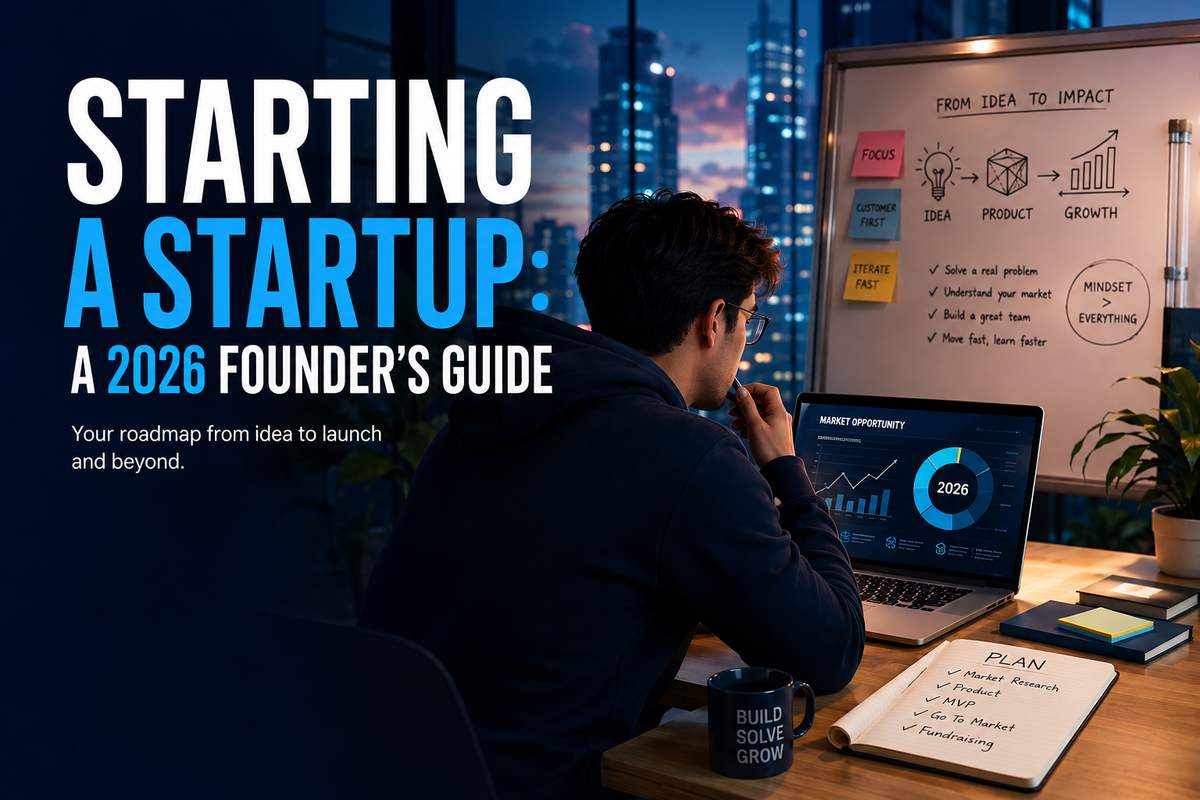

There’s no denying that starting a startup in 2026 is both easier and harder than it used to be. It’s easier because AI tools have collapsed the cost of building a first version of almost anything. It’s harder because the bar for proving your idea actually works has never been higher. Global venture funding hit roughly $425 billion in 2025. That’s a real jump from the year before. But 90% of startups still fail. Forty-two percent of those failures come down to one thing: building something nobody wanted in the first place.
That gap between “funding is up” and “most startups still fail” is the whole story. Capital exists. What’s scarce is proof. Here’s how to actually get from an idea to a business that survives past year one.
Validate before you build
The biggest mistake founders make is treating an MVP as a smaller version of the final product. That’s the wrong frame. An MVP is a validation tool, not a preview. Its only job is to prove that real people will commit time, money, or attention to the problem you’re solving. Do that before spending months building features nobody asked for.
Start narrower than feels comfortable. Pick one painful problem for one specific type of user. Build just enough to solve it end to end. A landing page that measures signup interest tells you more in a week than a polished six-month build tells you in six months. So does a single-feature tool that solves one workflow. If the product can’t produce a clear signal, like people returning to use it again or actually paying for it, it isn’t lean. It’s just incomplete.
Talk to potential users before writing any code. Their actual complaints should shape what you build first, not your assumptions about their complaints. This sounds obvious. It’s also the step most founders skip because it’s slower and less exciting than building.
Fund it without waiting on early VC
Chasing venture capital first is not the only path. For most founders, it isn’t even the best one. Forbes recently broke down research showing that 94% of America’s unicorn founders built their companies without early VC funding. They used capital-efficient strategies and kept control of their company. Investors came in later, once there was already proof the business worked.
That doesn’t mean VC is bad. It means treating it as the default first move is usually a mistake. Personal savings, revenue from early customers, and small business loans can all fund a first version. None of them require giving up equity or control before you know what your company is actually worth. Save the VC conversation for after you have traction to show, not just a pitch deck.
Build a lean plan, not a 40-page deck
A business plan still matters, but its job in 2026 is different than it used to be. Investors and early hires care less about polished five-year financial projections. They care more about a few sharp answers: what problem are you solving, for whom, and what evidence do you have that it’s real?
Keep the core plan short. Cover the problem, the target customer, how you’ll reach them, and what it actually costs to acquire and keep a customer. Investors weighing in on the 2026 startup market have made clear that scale and application matter more than a story about the underlying technology. A business plan should read like evidence, not a sales pitch.
Build your team without over-hiring
AI-assisted workflows now let small teams do work that used to require a much larger headcount. That doesn’t mean you should hire nobody. It is a reason to hire slower and more deliberately than founders did a few years ago. Bring people in when a specific gap is actively costing you time or money. Don’t hire just because a team of one feels lonely.
When you do hire, prioritize people who can operate across more than one function early on. A generalist who can handle support, some marketing, and light product work is worth more in month three than a narrow specialist you don’t have enough work to fill. Getting team culture and productivity right early matters more when the team is small. One disengaged early hire has an outsized effect on a five-person company.
Automate what doesn’t need a person
Once the product is live, resist the urge to build every internal process from scratch. A lot of early operational work doesn’t need a human doing it manually. Invoicing, scheduling, and basic customer support routing all fall into this category. Business process automation exists specifically to take that kind of task off a founder’s plate early, before it becomes a full-time job for someone.
The trick is doing this before the workload piles up, not after someone is already drowning in it. A founder spending three hours a week on manual data entry is a founder not spending that time on the product or the customer relationships that actually move the business forward.
Outsource what doesn’t need to be you
For anything that still needs a human but doesn’t need to be the founder, outsourcing narrow, well-defined tasks is often more practical than hiring in-house at this stage. Customer support tiers, bookkeeping, and routine design work are common first candidates. Each one has a clear scope and a measurable outcome, which makes it easy to tell whether the arrangement is working.
Keep anything requiring deep product judgment close to the founding team. That includes pricing decisions, core product direction, and anything involving sensitive customer data. Hand those off only once the company has enough structure to do it safely.
Where does this leave you?
Starting a startup in 2026 rewards founders who move fast on learning, not founders who move fast on building. Validate before you commit real money. Fund what you can without giving up control too early. Keep the plan sharp instead of long. Hire slowly, and let automation and outsourcing handle the parts that don’t need a founder’s judgment.
Success isn’t guaranteed by any of this. Most startups still won’t make it. But the ones that do tend to look a lot more disciplined early on than their pitch decks ever let on.