
Quick confession before we start. I’m an iPhone user, and I haven’t owned a Pixel. So this isn’t a “six months with both phones” piece. It’s a straight look at the specs, the reviews and the prices, from someone with no team loyalty here.
And honestly, that might help. Pixel fans tend to love every new Tensor chip. iPhone people like me just want to know: is the newer one actually worth more money?
If you’re still stuck on the bigger choice, I’ve already broken down iPhone vs Android separately. This one assumes you’ve picked Android and just want the right Pixel.
Here’s the twist, too. The Pixel 11 launched in August 2026. So the real question now isn’t which is the newest. It’s which older Pro gives you the better deal.
Pixel 9 Pro vs Pixel 10 Pro: What Actually Changed?
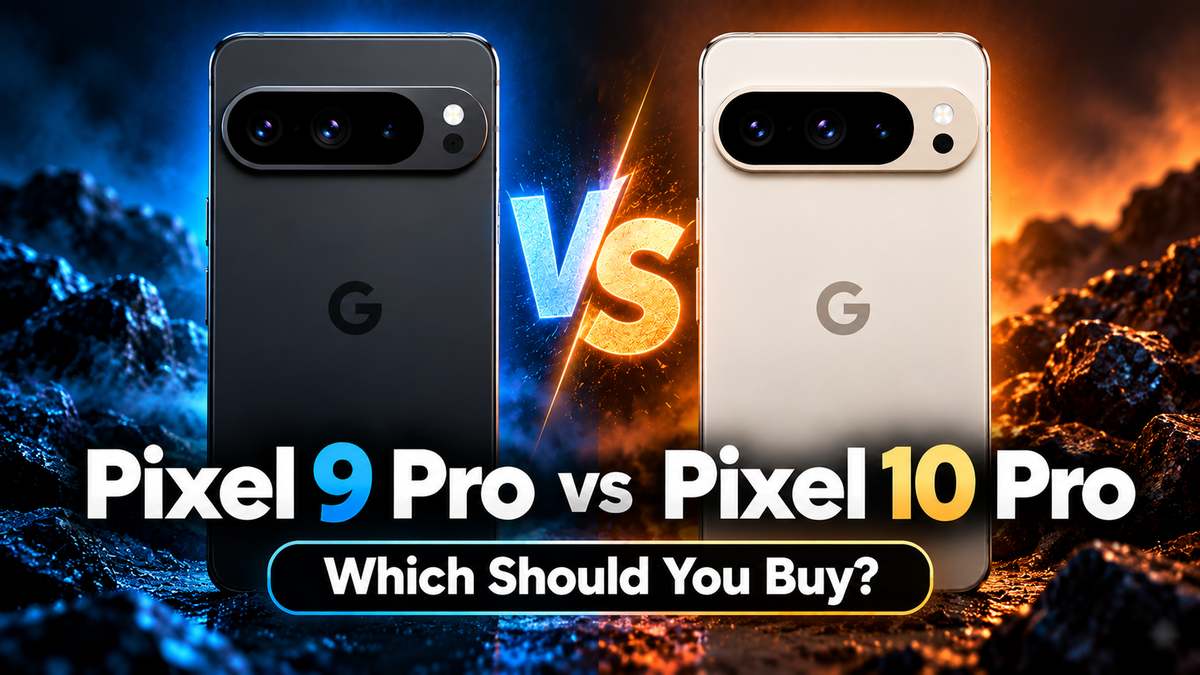
Not as much as you’d think. Both launched at $999, both have a 6.3-inch 120 Hz screen, 16GB of RAM, and the same three rear cameras. The Pixel 10 Pro mostly adds a newer chip, a slightly bigger battery, magnetic charging and more AI features.
Here are the main differences, based on a side-by-side spec breakdown:
- Chip. Tensor G5 (3 nm) on the 10 Pro vs Tensor G4 (4 nm) on the 9 Pro.
- Brightness. 3,300 nits peak vs 3,000 nits.
- Battery. 4,870 mAh vs 4,700 mAh.
- Wired charging. 30W vs 27W.
- Magnetic charging. The 10 Pro has built-in Qi2 magnets, which Google calls Pixelsnap. The 9 Pro doesn’t.
- Weight. 207 g vs 199 g. The newer one is a bit heavier.
Performance and Heat
So, is the Tensor G5 a big jump? On paper, Google claims a 34% faster CPU. In real use, reviewers found it hard to notice.
The bigger win is heat. TSMC now makes the chip, and early testing found the G5 runs cooler than the G4 did in everyday use. That was a real complaint on the Pixel 9 series, so it matters.
Gaming is still the weak spot, though. The GPU trails rival chips, and demanding games like Genshin Impact can’t hold 60fps at max settings. So in the Pixel 10 Pro vs 9 Pro debate, heat is the difference you’ll actually feel, not speed.
Cameras and AI
The camera hardware is identical: a 50MP main, a 48MP ultrawide, a 48MP 5x telephoto and a 42MP selfie camera. What’s new is software. The 10 Pro adds Pro Res Zoom, which uses AI to push zoom up to 100x.
It also gets newer AI features like Magic Cue, which surfaces info from your apps before you ask, and Camera Coach, which gives tips while you shoot. Useful, maybe. But I’m not sure many people will pick a phone over those alone.
Which Should You Buy Now That the Pixel 11 Is Out?
The Pixel 9 Pro, if you find it at a good discount. The Pixel 10 Pro, if the price gap is small. Since the Pixel 11 launched with the Tensor G6 in August 2026, both older models should keep dropping in price.
Here’s how I’d think about it:
- Pick the Pixel 9 Pro if you want the best value. Same cameras, same screen size, same RAM. You lose some AI tricks and magnetic charging, and that’s about it.
- Pick the Pixel 10 Pro if heat bothered you on older Pixels or if you want Qi2 accessories. Cooler running is a genuine quality-of-life upgrade.
- Skip both if you want the latest features. Then you’re really shopping for a Pixel 11.
How Long Will Each Get Updates?
This is the part people forget. Both phones get seven years of Android and security updates from launch. So the 9 Pro should be supported into 2031, and the 10 Pro into 2032. Either way, you’re covered for a long time.
Pixel 9 Pro vs Pixel 10: The Base Model Question
Some people weigh the Pixel 9 Pro vs the Pixel 10, meaning the cheaper non-Pro model. It’s a fair comparison, honestly. The base Pixel 10 launched at $799, and it got the Tensor G5 and a telephoto camera for the first time on a non-Pro Pixel.
But the 9 Pro still has better camera hardware overall, plus 16GB of RAM versus 12GB on the base 10. If you find a 9 Pro at a similar price to a new Pixel 10, I’d lean toward the 9 Pro for photos. If you want the newer chip and longer support, the Pixel 10 makes sense.
Upgrading From a Pixel 6 or Pixel 7
If you’re on an older Pixel, this is where an upgrade actually feels big.
Pixel 7 vs Pixel 10
The Pixel 7 runs on the Tensor G2 and has no telephoto camera. The Pixel 10 brings a much newer chip, a brighter screen, a bigger battery, a 5x telephoto and magnetic charging. That’s a meaningful jump, not a minor one.
Pixel 6 vs Pixel 10
The Pixel 6 vs Pixel 10 gap is even bigger. The Pixel 6 used the first Tensor chip, which had well-known heat and battery issues. Google stretched Pixel 6 and 7 support to five years, which puts the Pixel 6 at the end of the line around now, in October 2026. The Pixel 7 gets about one more year.
That matters more than people realize. Old phones without updates are easier targets for scams and malware. Newer Pixels include built-in scam detection for calls and messages, which helps against tricks like the Amazon scam texts I’ve covered before.
Is the Pixel 10 Trade In Worth It?
Often, yes, especially during launch promotions. Google’s store and many carriers offer Pixel 10 trade-in credit for older phones, and the value depends on the model and condition. Check a few offers, because they vary a lot.
Before You Hand Over Your Old Phone
A few things to do first:
- Back up your photos and data. Google Photos and your Google account backup cover most of it.
- Sign out of your accounts. Streaming apps especially. My guide on how to sign out of Prime Video on TV also shows how to remove devices remotely.
- Factory reset the phone. This wipes your data and removes Google’s anti-theft lock, which trade-in programs need.
- Remove your SIM card. Easy to forget. Annoying to get back.
Where Pixel Phones Go From Here
I think Google’s Pro phones are settling into a pattern: small hardware changes, big AI changes. The Pixel 10 Pro proved that, and the Pixel 11 seems to continue it.
For buyers, that’s good news. It means last year’s Pro stays perfectly usable for years. Will I switch from my iPhone? Probably not anytime soon. But if I did, I’d grab a discounted Pixel 9 Pro and not lose any sleep over the missing AI tricks.
Frequently Asked Questions
Not really. The cameras and screen size are the same, and the main gains are a cooler chip, Qi2 magnets, slightly faster charging and new AI features. Most Pixel 9 Pro owners can skip it.
Yes, the hardware is the same: 50MP main, 48MP ultrawide, 48MP 5x telephoto and 42MP selfie. The 10 Pro adds AI-based Pro Res Zoom up to 100x.
The Pixel 10 Pro has a slightly bigger battery at 4,870 mAh versus 4,700 mAh, and its cooler chip should help too. The difference isn’t huge.
Not built in. It supports wireless charging, but you need a magnetic case to use Qi2 accessories. The Pixel 10 Pro has magnets built in.
It handles casual games fine. Demanding titles at max settings struggle, and online games depend heavily on your connection, so reducing ping matters as much as the phone itself.