When I started Technwz, I genuinely believed that if I published a lot, the traffic would come. Weeks went by with posts just sitting there, getting almost nothing. Now I know that’s not how it works.
That’s the first thing nobody tells you about SEO. Publishing anything does not get you traffic. Publishing the right thing, in the right way, for the right search, does. Maybe you’ve searched how to make your website show up on Google and found a dozen guides that made it sound way harder than it is.
So this is the SEO 101 guide I wish I’d read back then. No jargon walls, no 40-step checklists. Just the stuff that actually moves a new site. If you’re still on the fence, I wrote a separate piece on whether SEO is even worth it in 2026. This one assumes you’ve decided it is.
What Is SEO, in Plain Words?
SEO, or search engine optimization, is the work of getting your pages to show up when people search on Google. That’s it. You make pages Google can find, understand and trust enough to put in front of someone.
Everything else is detail. Important detail, sure. But detail.
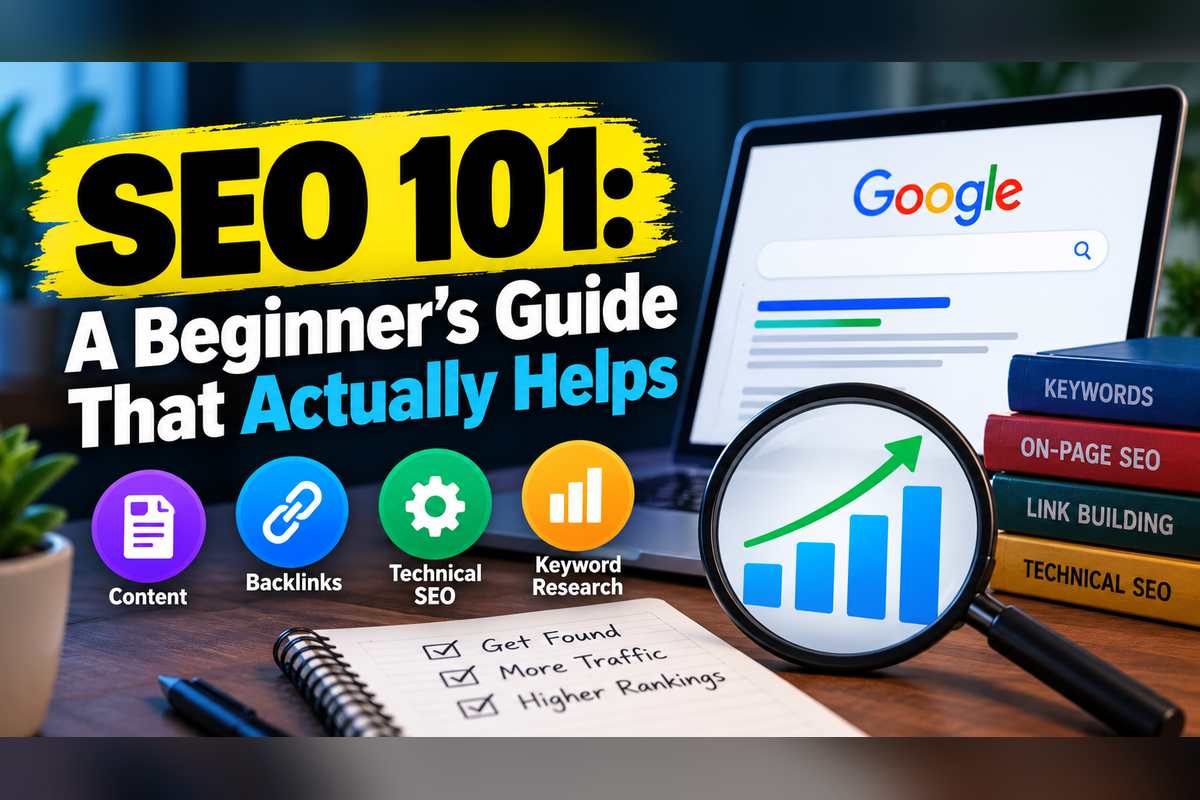
I like to break it into three SEO parts, because that’s how the work actually splits on a real site:
- Technical SEO. Can Google reach and read your pages? Speed, mobile layout, sitemaps, and nothing broken hiding in the background.
- On-page SEO. Does each page clearly answer one search? Titles, headings, the words themselves, and internal links.
- Off-page SEO. Do other sites trust you enough to link to you? This is mostly links and mentions, and it’s the slowest part by far.
Every beginner guide to SEO covers these three, one way or another. The names change. The split doesn’t.
How Does Google Decide What Ranks in 2026?
Google ranks the pages it thinks best answer a search, and in 2026 it leans hard on originality and real experience. It ran two broad core updates this year, one in March and one in May. Both shook up rankings, and the March one in particular pushed down thin, rewritten content.
There’s no denying that search itself looks different now too. Google’s AI Mode passed one billion monthly users in May, and AI Overviews reach more than 2.5 billion. Google even redesigned its search box for the first time in about 25 years, so it can take longer, chattier questions.
What That Means for Your SEO Position
Here’s the thing. Your SEO position still matters, but the top spot isn’t the whole prize anymore. A page can rank third and still get quoted inside the AI answer above everything else. Google tends to pull those quotes from pages that already rank well and answer clearly.
Learning how to get on the first page of Google used to be the entire goal. Now you want to rank, and you want to be the clearest answer on the page. Same work, mostly. Just a sharper focus on actually answering the question near the top.
What SEO Topics Should a Beginner Learn First?
Start with keyword research, on-page basics and internal linking. Those three SEO topics give you the most return in your first few months. Technical SEO and link building can wait a bit, unless your site is actually broken.
I know that sounds backwards. Most guides open with crawl budgets and schema markup. But a beginner with a slightly slow site and great content will beat a beginner with a perfect site and nothing worth reading. Every time, honestly.
If you run WordPress, which most of us do, WordPress SEO for beginners is mostly about installing one decent plugin. I use Yoast on Technwz. It handles sitemaps, meta descriptions and a lot of the boring technical stuff without you thinking about it. That frees you up for the part that matters, which is the writing.
What Are the Steps of SEO?
The basic steps of SEO are simple: find a keyword you can win, write the best page for it, link it properly, get it indexed, and wait. Then you measure and fix. That loop is pretty much the whole job, repeated forever.
Before You Write
- Pick a keyword you can actually win. New sites can’t rank for the huge, competitive terms. Not yet. Go after longer, more specific searches with lower difficulty. I check difficulty in SEMrush, but free tools give you a rough idea too. Some AI chatbots are surprisingly decent at brainstorming related questions.
- Look at what already ranks. Search the keyword yourself. If the top results all come from huge brands, maybe skip it. If they’re thin or outdated, that’s your opening.
- Write for the person, not the keyword. Answer the question early. Then go deeper. Put the useful facts near the top, not buried in paragraph nine.
After You Hit Publish
- Link it from your other pages. More on this below, because beginners skip it constantly.
- Get it indexed. I request indexing in Google Search Console for every new article. If you’ve ever typed “how to make my site appear on Google” late at night, this step is usually the fix. I also added Technwz to Bing Webmaster Tools recently, which took about ten minutes.
- Earn a few links over time. Not bought ones. Real links from relevant sites still boost Google ranking more than almost anything else off-page.
- Check back in a couple of months. Then update whatever isn’t working.
Why Does Internal Linking Matter So Much?
Internal linking tells Google which of your pages matter and how they connect. It’s also the easiest way to boost search engine rankings for pages you’ve already written. And it costs nothing.
To illustrate, say you write a guide on gaming RAM. Then you write one comparing DDR5 vs DDR4. If those two pages don’t link to each other, Google treats them like strangers. Link them with natural anchor text, and suddenly they support each other. The whole topic gets stronger.
I learned this the slow way. Early on, I’d publish an article and just… leave it there, alone, with nothing pointing to it. Some of those pages took forever to even show up.
My rule now is simple. Every new article links out to two or three related posts on the site. And I go back to older posts and link to the new one. That second part is what most people forget, and honestly it does more of the work.
How Do I Get My Website on Google’s First Page?
You get there by targeting searches you can realistically win, publishing the most useful page for each one, and linking your pages together well. Then you wait, usually two to three months for a new page on a small site. No trick skips the wait.
I’ll be honest, that answer annoyed me when I started. Everyone wants to know how to get my website on Google first page by next week. But Google needs time to crawl a page, test it and decide where it fits.
How Long Does It Really Take?
On Technwz, newer articles usually start picking up impressions and rankings after about two to three months. Some move faster. Some take longer, especially on topics where bigger sites already dominate. Nobody can promise you how to get to page 1 on Google in a set number of days.
If you want to rank higher sooner, the lever isn’t a hack. It’s choosing easier keywords. That’s really how to get on top of Google search as a small site. You don’t fight the big players head-on. You go where they aren’t.
Local businesses get one extra shortcut. If you’re wondering how to rank higher on Google My Business, fill out your profile completely, add real photos and collect genuine reviews. For “near me” searches, that profile often matters more than your website.
White Hat vs Black Hat SEO: What’s the Difference?
White hat search engine optimization follows Google’s rules: useful content, honest links and a site that works well. Black hat SEO tries to trick the algorithm with keyword stuffing, hidden text, link farms and spun pages. One builds slowly. The other can wipe a site out overnight.
That’s really the whole answer to what is white hat and black hat SEO. Sure, black hat sometimes works for a few weeks. But Google keeps getting better at catching it. It ran a spam update in March, just before its first core update of 2026, and several more since.
I’ve never tried black hat on Technwz, and I don’t plan to. The risk just doesn’t make sense for a site I’m building for the long run. One penalty, and months of work can vanish. Black hat sellers love to promise they know how to get to the top of Google overnight. I’d be skeptical of anyone who says that.
The same goes for black hat marketing in general: fake reviews, bought followers, that kind of thing. It looks like a shortcut. It’s usually a debt you pay later.
If you ever hire outside help, look for a white hat SEO expert who explains exactly what they’ll do. Vague answers are a red flag.
Is Learning SEO Worth Your Time?
Yes, if you run a site, a blog or a small business. The benefits of learning SEO go beyond rankings. You start to understand what readers actually want, and you stop wasting time on posts nobody will find.
It also shows you how SEO helps in digital marketing more broadly. Every ad, email and social post works better when it points to a page people trust. SEO is basically that trust, built page by page.
You don’t need a course to start, either. A good beginners guide to search engine optimization, a free Search Console account and a bit of patience will take you surprisingly far. I’d argue patience is the hardest of the three.
Where to Go From Here
My advice? Pick one keyword this week. Write the most genuinely useful page you can for it. Link it to two other posts. Request indexing. Then leave it alone for a while.
Knowing how to get your website on Google first page isn’t some secret formula. It’s that small loop, repeated with a bit more skill each time. Search will keep changing, with more AI answers and fewer plain blue links. But clear, original pages from people who actually know the topic? Google keeps rewarding those. I’m betting my own site on it, anyway.