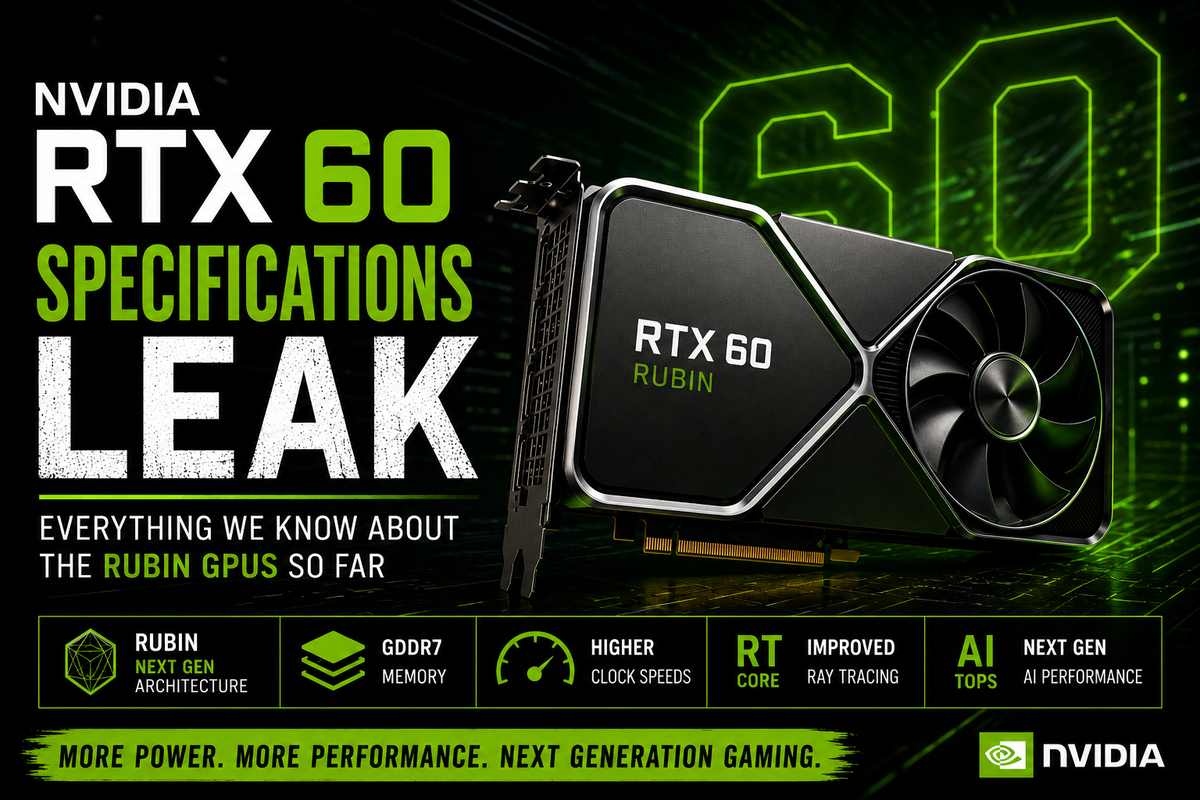

The Nvidia RTX 60 specifications leak has been making the rounds for a few months now, and honestly, it’s one of the more interesting GPU rumor cycles I’ve followed in a while. Not because the numbers are shocking. They’re not, really. It’s particularly revealing because of what the leak says about where Nvidia thinks gaming is headed.
Here’s the thing: if these leaked RTX 60 specs are even half accurate, Nvidia is basically telling us that raw rasterization is done as the main selling point. The next generation is all about path tracing, neural rendering, and AI doing the heavy lifting. Whether you like that direction or not is a separate debate. But the leaked details paint a pretty clear picture, so let’s go through all of it.
Quick disclaimer before we start. None of this is official. Nvidia has not confirmed a single spec, name, or date for the RTX 60 series. Everything below comes from leaks and rumors, and I’ll tell you exactly how credible each piece is as we go.
Where the RTX 60 Leak Actually Came From
The main specifications leak traces back to YouTuber RedGamingTech, who published the details in late March 2026. From there it spread everywhere, and outlets like Overclock3D covered the claims in detail within days.
Now, RedGamingTech has a mixed track record. Some of his past calls landed, some didn’t. That’s just the reality of GPU leaks, and I want to be upfront about it rather than pretend this is gospel.
There’s a second, more credible thread here though. Kopite7kimi, who is probably the most reliable Nvidia leaker out there, independently confirmed back in January 2026 that the RTX 60 series will use the Rubin architecture with GR20x silicon. So the foundation of this leak, meaning the architecture and chip naming, has support from multiple sources. The performance numbers and memory configs are where things get shakier.
In a nutshell, the skeleton of the RTX 60 leak is probably right. The flesh on it is less certain.
The Headline Claim: 2x Path Tracing Performance
The single biggest claim in the Nvidia RTX 60 specifications leak is this: the RTX 60 series is targeting double the path tracing performance of the RTX 50 series. Two times. Not 20 or 30 percent, but a full 2x generational jump in path traced workloads.
Raster performance is a different story. The leak puts traditional rasterization gains at around 30 to 35 percent SKU-to-SKU over Blackwell. That’s a decent uplift, don’t get me wrong, especially compared to the RTX 40 to RTX 50 transition which was underwhelming in pure raster. But it’s clearly not where Nvidia is spending its transistor budget.
Sure, a 2x path tracing claim sounds like marketing fantasy. However, there’s actually a logical reason for Nvidia to chase this. The PlayStation 6 and Microsoft’s next Xbox are both expected to push hard on ray tracing hardware, and Nvidia needs its cards to stay comfortably ahead of consoles. If the next console generation delivers convincing path traced visuals, an Nvidia flagship that only wins by a small margin looks bad.
The leaked specs also mention 6th generation Tensor Cores and 5th generation RT Cores doing most of this work. The gains come from architecture, not from massively bigger dies. That part I actually believe, because die sizes are already enormous and 3nm wafers are expensive.
Leaked RTX 6090, RTX 6080, and RTX 6070 Specs
Let’s get into the actual card-by-card numbers, because this is what most people searching for the RTX 60 specifications leak want to see.
RTX 6090. The rumored flagship uses the GR202 chip with up to 192 SM units on the full die. For context, the RTX 5090 has 170 SMs, so that’s roughly a 13 percent bump if Nvidia enables everything, which it almost never does on consumer cards. Memory stays on a 512-bit bus with 32GB of GDDR7, and clock speeds reportedly land between a high of 2GHz and a low of 3GHz.
RTX 6080. In my opinion, this one receives a more meaningful upgrade. The GR203-based card reportedly moves to a 320-bit memory bus with 20GB of VRAM. That’s a 64-bit bus increase over the RTX 5080 and, finally, more than 16GB on an 80-class card.
RTX 6070. The GR205 chip with a 256-bit bus and 16GB of GDDR7. Again, a 64-bit jump over its predecessor, which TechPowerUp notes translates to significantly more memory bandwidth for the mid-range.
The pattern here is obvious. The 6090 barely grows, and the real generational movement happens in the 80 and 70 class cards. Honestly, that’s the correct call. The 5070’s 192-bit bus always felt stingy to me, and a 33 percent wider bus on the 6070 fixes a genuine weak point.
The Rubin Architecture and TSMC 3nm
The RTX 60 series will reportedly use Nvidia’s Rubin architecture, and this part is close to a lock at this point.
Rubin already exists. It’s Nvidia’s next data center architecture, announced officially and headed to AI hardware in the second half of 2026. What the leaks tell us is that gaming cards will reuse this architecture rather than getting something custom, following the same playbook as previous generations. Tom’s Hardware reported that analysts even found dormant graphics-specific hardware blocks inside the Rubin CPX accelerator, which only makes sense if Nvidia planned to repurpose the silicon for GeForce all along.
On the manufacturing side, the leak points to a TSMC 3nm FinFET node. It is possibly a custom variant, similar to how Nvidia created its 4N node from TSMC’s 5nm process. Nothing exotic, no sub-2nm gamble.
This node change matters more than it sounds. The RTX 50 series ran on essentially the same process as the RTX 40 series, and that’s a big part of why Blackwell’s gains felt so flat. A 5080 barely beats a 4080 Super in pure raster once you strip out the frame generation tricks. Rubin moving to 3nm provides Nvidia actual physics-level headroom to work with for the first time in two generations. Real density gains, real efficiency gains, not just architectural rearranging.
DLSS 5 and the Neural Rendering Push
Alongside the hardware leak, the software side is also important.
The 6th-gen Tensor Cores in the RTX 60 series are reportedly built to accelerate DLSS 5, which moves beyond upscaling into full neural rendering. We’re talking about AI generating and augmenting game assets and effects in real time, not just cleaning up a lower-resolution image. Nvidia’s early DLSS 5 demo reportedly needed two RTX 5090s to run, so the goal for Rubin is to bring that workload down to a single card, including mid-range ones.
Jensen Huang said as much at CES 2026, stating that the future of gaming graphics is less about raw rasterization and more about neural rendering. When the CEO says the quiet part out loud on stage, the leaked hardware priorities suddenly make a lot of sense.
To illustrate what this shift means practically: the 30-35 percent raster gain is the floor, and everything above that comes from AI features. Whether you consider DLSS frames “real performance” is a debate I’m not settling today. But it’s clearly the direction, and anyone buying into the RTX 60 series is buying into that vision whether they like it or not.
RTX 60 Release Date: Prepare to Wait
This part is where the news gets less fun. The RTX 60 release date keeps sliding.
The original expectation was a CES 2027 reveal with cards arriving through 2027, following Nvidia’s usual two-year cadence. Kopite7kimi pointed to the second half of 2027 for availability. That alone means the RTX 50 series has one of the longest runs of any Nvidia generation.
Then the DRAM crisis became a factor. TweakTown reported that Nvidia has scrapped the RTX 50 Super refresh entirely for 2026 and pushed the Rubin gaming timeline back further, citing reporting from The Information. Some outlets now float late 2027 or even early 2028 for actual availability.
So the realistic picture looks like this. No new Nvidia gaming GPUs at all in 2026. A possible RTX 60 announcement at CES 2027 and real cards on shelves somewhere between the second half of 2027 and early 2028. Memory prices will decide which end of that window we get.
I’ll keep this section updated as new information drops, because release timing is the piece most likely to change.
Should You Wait for the RTX 60 Series or Buy Now?
The honest answer depends on what you’re running today, and I’ll give you my actual opinion rather than a wishy-washy, both-sides answer.
If you’re on an RTX 30 series card or older and gaming feels rough, buy now. Waiting 18+ months for a generation that will probably launch expensive and supply-constrained is not a plan, it’s a hope. The RTX 50 series and AMD’s current lineup handle everything on the market today, including the demanding stuff coming this year. If you’re building for GTA 6 on PC, the games you actually want to play will run great on current hardware long before Rubin ships.
If you’re on an RTX 40 or 50 series card, wait. Easily. Your card is fine, the raster jump to Rubin is modest anyway, and buying a 50 series flagship this late in its cycle at current prices makes very little sense.
There’s one more angle worth mentioning. With DRAM prices doing what they’re doing, the whole platform cost is climbing, not just GPUs. Memory got expensive across the board, something we covered in our DDR5 vs DDR4 comparison, and that pressure is exactly what’s delaying these cards in the first place. A full Rubin-era build in 2027 might cost noticeably more than an equivalent build today. Something to factor in.
How Credible Is This Leak, Really?
I want to close the analysis with some honest skepticism, because not everyone reporting on this leak has bothered.
VideoCardz, which tracks GPU rumors more carefully than almost anyone, pushed back on the performance claims and noted that Nvidia hasn’t actually finalized its next-generation gaming GPUs yet. TechSpot summarized the situation well: the detailed spec sheets floating around right now are educated guesswork rather than information grounded in company guidance.
So here’s my personal credibility ranking of the claims:
Very likely true: Rubin architecture, GR20x chip naming, TSMC 3nm process, heavy neural rendering focus. Multiple independent sources match Nvidia’s official data center roadmap.
Plausible: The memory bus upgrades on the 6080 and 6070, 32GB on the 6090, and clock ranges. These fit Nvidia’s patterns and respond to real criticisms of the current lineup.
Take with a big grain of salt: The 2x path tracing figure and the 30-35 percent raster number. Performance targets this early are usually internal goals at best, and internal goals move. A lot.
Nothing here is finalized, and Nvidia can change memory configs and clocks right up until months before launch. Which, again, is at least a year away.
Frequently Asked Questions
The RTX 60 series is Nvidia’s next generation of gaming graphics cards, expected to succeed the RTX 50 series. Leaks point to the Rubin architecture, GR20x chips, and a heavy focus on path tracing and neural rendering.
Nothing is confirmed. Leakers originally pointed to the second half of 2027, but reports of delays tied to the DRAM shortage suggest late 2027 or even early 2028 is possible.
The rumored RTX 6090 uses the GR202 chip with up to 192 SMs, a 512-bit memory bus, 32GB of GDDR7, and clocks between a low of 2GHz and a high of 3GHz.
Leaks claim up to 2x path tracing performance over the RTX 50 series, with more modest raster gains of around 30 to 35 percent. Treat both numbers as unconfirmed targets.
Reportedly no. The RTX 50 Super refresh planned for 2026 has been shelved due to memory supply constraints, according to multiple reports.
DLSS 5 is Nvidia’s rumored next step beyond upscaling, using AI for full neural rendering that generates and augments game visuals in real time. It’s expected to be a headline feature of the RTX 60 series.
Final Thoughts
The RTX 60 specifications leak tells a coherent story even if individual numbers end up wrong. Nvidia is betting the next generation on path tracing and AI rendering, the mid-range finally gets the memory it deserves, and none of it arrives until late 2027 at the earliest.
My advice is simple. Don’t plan purchases around these cards yet. Watch for kopite7kimi’s spec leaks later in the cycle, because that’s when the numbers start becoming real. And expect the release date conversation to shift at least once more before this generation ships.
This story will keep developing, and I’ll update this article as new leaks land. The next big checkpoint is likely CES 2027.