
Most organizations start their automation journey the same way: they find a repetitive task, automate it, and move on to the next one. For a while, this approach works. Errors drop. A few hours have been recovered. The team feels productive.
Then the complexity hits.
Processes that span multiple departments start breaking at the handoff points. Automations built in silos do not talk to each other. Someone changes a system and three bots stop working. The patchwork of task-level automations starts consuming as much management time as the manual work it replaced.
This is the point where organizations need to graduate from task automation to something more structured BPM automation and eventually to something more intelligent. This guide explains what each means, how they relate, and how to determine which approach fits your organization.
What is BPM automation?
Business Process Management (BPM) is a discipline that provides a systematic approach to understanding, designing, measuring, and improving the end-to-end processes that run your organization. BPM automation is what happens when that discipline is applied with technology: using software to execute, monitor, and optimize those processes rather than relying on manual coordination.
The distinction matters. BPM is not primarily a technology; it is a way of thinking about how work flows through an organization. The automation comes after the thinking.
As one widely cited definition from TechTarget puts it, BPM is about understanding how work is completed in your organization and how it connects to higher-level business objectives. Knowing the sequence of steps in a process, how much they cost, how often they run, how often they produce errors, and how many variations exist—this understanding is what enables meaningful automation.
When you implement BPM automation well, it doesn’t just make things work faster than they currently do. It is a redesigned, optimized workflow that eliminates unnecessary steps, reduces errors, and scales without adding headcount.
BPM automation vs task automation: the key difference
Task automation handles a single, isolated action: send this email, move this file, update this record. It is fast to implement and delivers quick wins, but it does not manage the process around the task.
BPM automation manages the entire workflow from the triggering event through every step, decision, human interaction, and system integration, all the way to the final output. It handles routing logic, exception management, escalations, approvals, audit trails, and performance monitoring as a connected system.
The difference in practice: task automation sends an invoice approval email. A BPM automation manages the entire purchase-to-pay process by raising the purchase order, matching it to the invoice, routing it for approval based on amount and department, escalating if approval does not arrive within 48 hours, posting the approved payment to the accounting system, and logging every action for compliance.
What is intelligent business process automation?
Intelligent business process automation (iBPA) goes beyond BPM automation by adding artificial intelligence, especially machine learning, natural language processing, and, more and more often, generative AI, to manage processes that use unstructured data, have variable inputs, or require decisions that cannot be reduced to fixed rules.
Traditional BPM automation works well for processes where the logic is consistent: if X, do Y. Intelligent automation works for processes where the right action depends on context, pattern, or interpretation—things a rule-based system cannot handle reliably.
The practical difference is significant. A standard BPM automation can route an invoice for approval. An intelligent automation can read an unstructured vendor email, extract the relevant invoice data without a structured form, cross-reference it against existing purchase orders, flag anomalies that suggest potential fraud, and route it accordingly, all without a human touching it.
According to McKinsey research, organizations that combine AI with their automation strategy see 20 to 30 percent reductions in operational expenses and over 40 percent improvements in efficiency, significantly higher than what rule-based automation alone delivers.
The role of AI in making automation intelligent
Three AI capabilities are most commonly applied in intelligent business process automation:
Machine learning enables the system to recognize patterns and improve its decisions over time. A support ticket classification system that learns from how humans have categorized previous tickets is more accurate in month six than it was in month one without being manually reprogrammed.
Natural language processing (NLP) allows the system to read, interpret, and act on unstructured text emails, documents, chat messages, and forms that were not designed for machine processing. This is the capability that makes it possible to extract data from contracts, classify customer complaints by sentiment, or generate accurate summaries of lengthy reports.
Generative AI is the newest addition to the intelligent automation toolkit. It can draft responses, generate documentation, create workflow logic from plain-language descriptions, and assist in process design in ways that were not possible with earlier AI approaches. According to a McKinsey report, generative AI helped 50% of organizations reduce the cost of HR activities and over 45% reduce costs in service operations.
RPA, BPM, and intelligent automation: understanding the differences
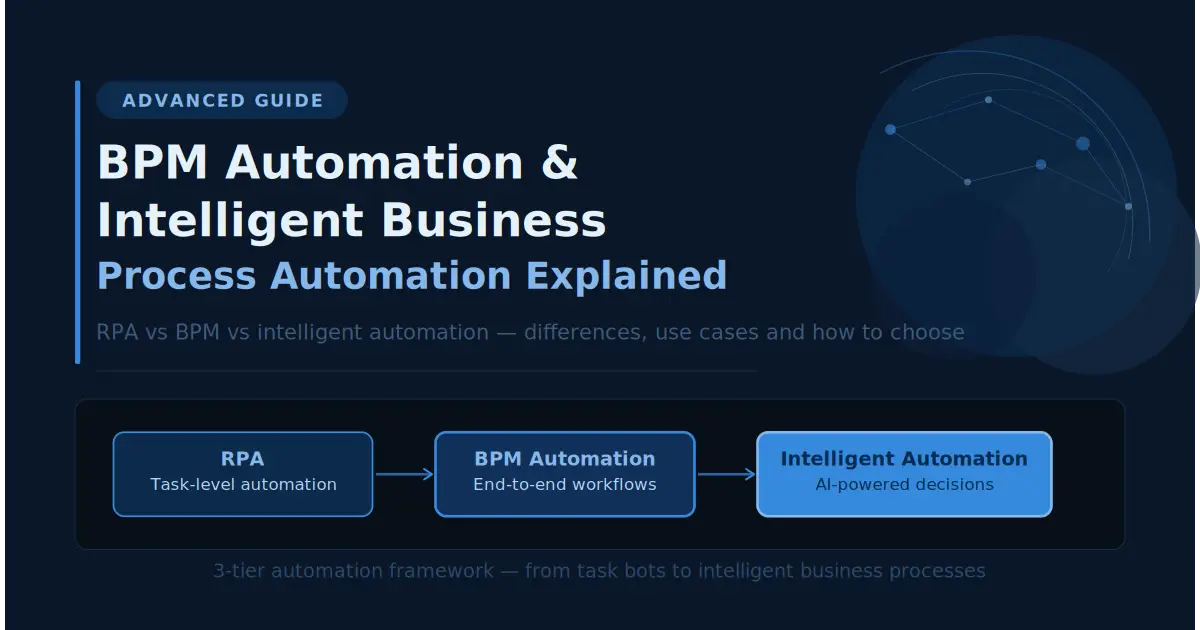
Vendor marketing often uses these three terms interchangeably, which creates genuine confusion. They are not the same thing. Here is a precise breakdown:
|
Technology |
Focus |
Mechanism |
Best suited for |
|
RPA |
Task-level automation |
Software bots mimic human UI interactions clicking, copying, typing |
Repetitive, rule-based tasks across legacy systems that lack API access |
|
BPM automation |
End-to-end process management |
A workflow engine orchestrates steps, decisions, and systems across the organization. |
Complex, multi-step processes involving multiple systems and human decision points |
|
Intelligent automation |
Context-aware, adaptive automation |
AI and ML handle unstructured inputs, pattern recognition, and variable decisions |
Processes with unstructured data, judgment-dependent decisions, or continuous improvement requirements |
The important nuance: these are not competing alternatives. They are complementary layers that work best together.
RPA excels at the task level, automating the repetitive, high-volume interactions with legacy systems that do not have modern APIs. But unmanaged RPA at scale leads to what practitioners call “bot sprawl“: dozens of brittle bots with no central governance, high maintenance overhead, and no end-to-end visibility.
BPM automation provides the governance layer that RPA needs. A BPM platform can orchestrate RPA bots as components within a larger process, managing when they run, handling their exceptions, and monitoring their performance alongside human steps, system integrations, and decision logic.
Intelligent automation is built on both, adding the ability to handle tasks and decisions that neither rule-based RPA nor standard BPM can manage alone.
As McKinsey has noted, organizations need holistic optimization programs to maximize ROI from automation. Implementing individual technologies in silos consistently underdelivers. The organizations seeing the strongest results are those that integrate all three layers, with BPM providing the structural backbone.
Core components of a BPM automation system
Understanding what a BPM automation system actually contains helps you evaluate platforms and understand what you are building toward.
Process modelling and design
The foundation of any BPM system is the ability to map, model, and document processes visually. Modern BPM platforms use BPMN (Business Process Model and Notation), a standardized visual language for representing workflows, to create process maps that both technical teams and business stakeholders can read and validate.
This modeling capability is not just for documentation. It is the specification that the automation engine executes. Changes to the process model propagate directly to how the automation runs, making updating and improving processes significantly faster than rewriting code.
Workflow execution engine
The execution engine is the core of BPM automation, the component that actually runs the process. It controls how work moves between systems and people, makes sure business rules are followed at each decision point, handles steps that happen at the same time or one after the other, manages timers and escalations, and ensures that every instance of the process follows the defined logic.
A robust execution engine handles not just the happy path but also the full range of exception scenarios: missing data, failed integrations, delayed approvals, and edge cases that would break simpler automation approaches.
Human task management
Not every step in a business process can or should be automated. BPM automation handles the human steps in a process just like the automated ones. It sends tasks to the right person or queue, provides context and relevant data when decisions are made, tracks how long tasks take, and escalates when tasks take too long.
This human-in-the-loop capability is one of the things that distinguishes BPM automation from pure task automation. A BPM system treats human decision points as first-class components of the workflow, not as gaps between automated steps.
Integration layer
A BPM system without integration capability is a process map that cannot execute. The integration layer connects the BPM platform to the systems that hold the data and perform the actions: CRM, ERP, HR platforms, finance systems, communication tools, and external APIs.
The quality of this integration layer is often the most important practical differentiator between BPM platforms. Broad, reliable, pre-built integrations with the systems an organization already uses reduce implementation time significantly and improve reliability in production.
Analytics and process intelligence
A BPM system generates a complete record of every process instance, showing when each step started and completed, which path was taken at each decision point, where exceptions occurred, and how long the overall process took. This data is the raw material for process intelligence.
Analytics built on this data reveal bottlenecks, highlight where exception rates are highest, surface the steps where cycle time variability is greatest, and track improvement over time. This closed-loop visibility, which spans process design, execution, and measurement, enables the continuous improvement that BPM promises.
BPM automation use cases across industries
Banking and financial services
Financial services are the largest adopters of BPM and intelligent automation, accounting for roughly 28% of total hyperautomation market share, according to industry research. The reasons are straightforward: high transaction volumes, strict compliance requirements, complex multi-system processes, and significant consequences for errors.
Loan origination, collecting applications, performing credit checks, routing for underwriting approval, generating offer letters, and onboarding approved customers are some of the most commonly automated end-to-end processes in banking. A major bank cited in industry research reduced its loan processing time by 78% and saw a 20% increase in loan business after implementing BPM automation across this process.
Know Your Customer (KYC) compliance, account opening, fraud detection workflows, and payment processing are all areas where BPM automation combined with intelligent document processing delivers measurable improvements in both speed and accuracy.
Healthcare
Healthcare systems now carry out more than 30 billion automated tasks annually across scheduling, claims processing, and medication management workflows, according to recent industry data. BPM automation underpins most of these processes at scale.
Patient intake and scheduling, insurance verification, prior authorization requests, and billing validation are all multi-step processes with clear rules, high volumes, and significant error costs. A healthcare network mentioned in Kissflow’s research on automation reduced billing mistakes by 80% by using automated validation workflows. This directly stopped revenue loss and made it easier to correct mistakes by hand.
Intelligent automation is especially useful in healthcare document processing because it can extract structured data from unstructured clinical notes, lab results, and insurance correspondence, which standard BPM automation cannot do.
Manufacturing and logistics
In manufacturing, automation has already eliminated billions of manual working hours. BPM automation manages the process layer—purchase order management, supplier onboarding, quality assurance workflows, maintenance request routing, and production planning processes that span multiple systems and organizational units.
A manufacturer that was studied in automation research cut the time it took to plan production by 60% by using integrated BPM automation to connect systems that were previously separate. The gain came not from faster individual tasks but from eliminating the handoff delays and coordination overhead between steps that previously required manual intervention.
SaaS and technology companies
For technology businesses, BPM automation helps with operational processes that become much more complex as the company grows like customer onboarding, subscription management, support escalation workflows, compliance processes, and internal operations (procurement, HR, and finance) that slow things down as headcount increases.
The particular value in SaaS environments is process consistency at scale. When onboarding the first 100 customers, manual coordination is manageable. When onboarding 1,000 per month, manual coordination breaks down. BPM automation makes the process consistent, measurable, and scalable without proportionally increasing headcount.
How to choose a BPM automation platform
The market for BPM and intelligent automation platforms is large and growing; the BPM market alone is projected to reach $61 billion by 2030, according to Research and Markets. Choosing the right platform is a consequential decision. These criteria help narrow it down.
Integration with your existing systems
The most important practical criterion is whether the platform integrates reliably with the systems your processes already touch. A BPM platform that requires custom development to connect to your CRM, your finance system, and your HR platform will cost significantly more to implement and maintain than one with pre-built, tested connectors.
Audit the systems involved in your highest-priority processes before evaluating platforms, and verify integration depth — not just whether a connector exists, but whether it supports the specific operations you need.
No-code and low-code capability
The speed at which you can build, test, and update automations depends heavily on how much of the work requires engineering resources. Modern BPM platforms offer drag-and-drop process design, visual rule configuration, and no-code workflow builders that allow operations and business teams to build and modify automations without developer involvement.
This capability matters not just for initial implementation but for ongoing maintenance. Processes change. The ability to update a workflow in hours rather than weeks is a significant competitive advantage.
Process monitoring and analytics
Evaluate how thoroughly the platform captures execution data and how accessible that data is for analysis. A platform that executes processes reliably but provides minimal visibility into performance is significantly less valuable than one that gives you real-time dashboards, exception alerts, and historical trend data.
Real-time visibility into where a process is running, failing, and slowing down transforms BPM automation from a cost-reduction exercise into a continuous improvement engine.
Scalability and total cost of ownership
BPM platforms vary significantly in how costs scale with usage. Some charge per process, some per user, and some per transaction volume. Model your expected usage growth over two to three years and understand how the total cost of ownership evolves—a platform that is cost-effective at 10 processes may be prohibitively expensive at 100.
Also consider the ecosystem of office automation software surrounding the platform. Platforms that integrate tightly with the productivity tools your organization already uses, such as Microsoft 365, Google Workspace, and Salesforce, reduce integration complexity and training burden significantly.
Frequently Asked Questions
No. RPA automates specific, repetitive tasks using software bots that interact with application interfaces. BPM automation manages end-to-end workflows orchestrating tasks, systems, and human steps across an entire process. RPA is often used as part of a BPM-managed process, automating tasks within a larger workflow that BPM coordinates.
BPM automation handles processes with structured inputs and rule-based decision logic. Intelligent automation adds AI capabilities machine learning, NLP, and generative AI to handle unstructured data, pattern recognition, and decisions that cannot be reduced to fixed rules. Most mature automation programs use both: BPM for the process structure and governance and intelligent automation for the steps that require judgment or handle variable inputs.
ROI varies significantly by process and industry. Research consistently shows that organizations implementing BPM automation report cost reductions of 20 to 50%, cycle time reductions of 50 to 90%, and error rate reductions of 40 to 80% for the processes they automate. The BPM market’s sustained double-digit growth reflects the fact that organizations that implement it correctly see returns that justify continued investment.
A single, well-defined process with clear inputs and limited integrations can be automated in four to eight weeks from design to deployment. Complex, multi-system processes with significant exception handling typically take three to six months. The process definition phase, mapping the current state, redesigning the workflow, and specifying the automation are typically the longest parts of the project.
Start with a process that is high-frequency, rule-based, involves multiple systems or people, and currently suffers from delays, errors, or coordination overhead. Invoice approval, employee onboarding, and customer support escalation are consistently strong starting points across industries. For guidance on identifying and defining the right processes before you build, read our guide on how to define business processes to automate for operational efficiency.
Final Words
BPM automation and intelligent automation are not destinations; they are capabilities that compound over time. Each process you automate generates data that reveals the next improvement opportunity. Each intelligent automation you deploy becomes more accurate as it learns from more instances.
The organizations that gain the most from these efforts are not those that invest the most upfront. They are the ones that start with the right process, measure rigorously, and build the discipline to apply what they learn to the next one.
If you are earlier in your automation journey and looking for practical guidance on what business process automation services include and where to begin, that is the right place to start before moving on to BPM and intelligent automation at scale.