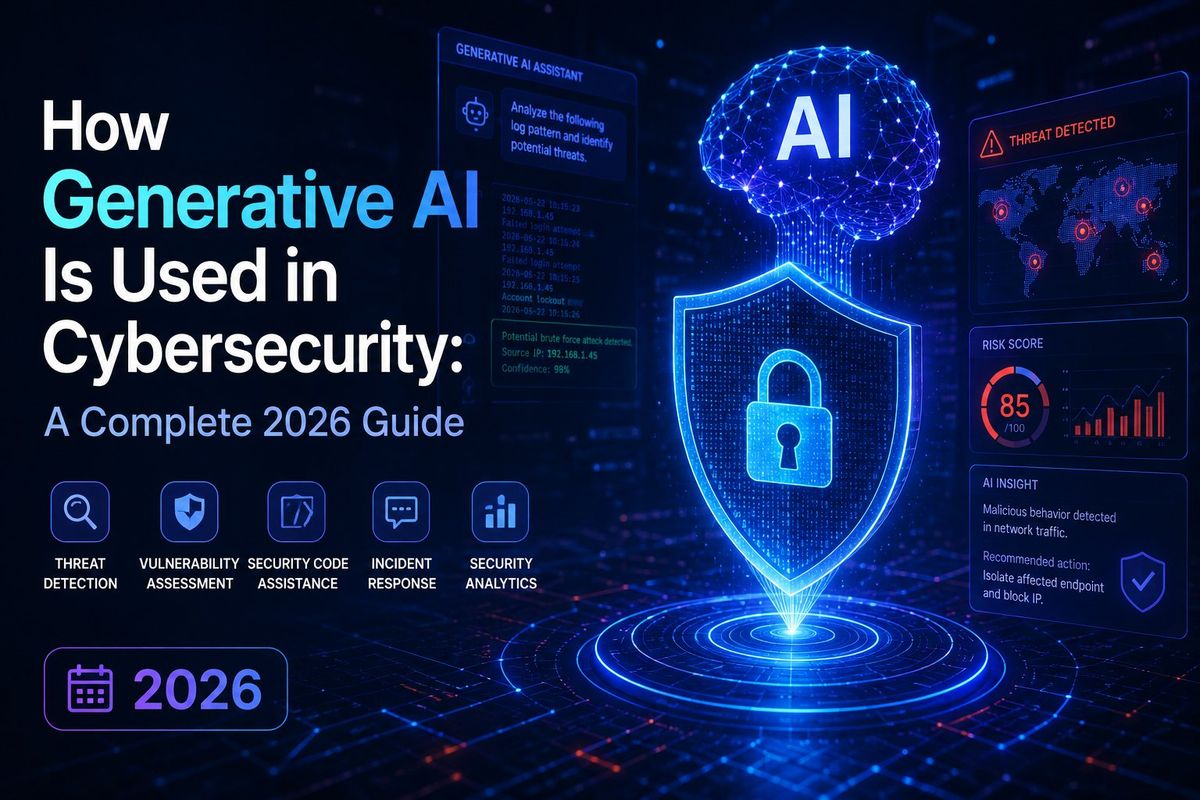

Cybersecurity has always been a cat-and-mouse game, but generative AI just changed the rules entirely. Defenders now have tools that can analyze millions of events per second, write automated incident playbooks, and even predict attacks before they happen. At the same time, attackers are using those exact same tools to craft flawless phishing emails and map out entire networks in minutes.
Understanding how generative AI is used in cybersecurity is no longer optional for security teams. Whether you’re a SOC analyst, an IT manager, or just someone who wants to understand where digital defense is headed, this guide breaks it all down with the latest data from 2025 and 2026.
The Generative AI Cybersecurity Market Is Exploding
Before diving into use cases, let’s look at the numbers. The scale of investment happening in this space is striking.
The global AI in cybersecurity market was valued at $34.09 billion in 2025 and is projected to grow to $213.17 billion by 2034, at a CAGR of 21.71% (Fortune Business Insights). Specifically within the generative AI segment, growth rates are even more aggressive. One report from SNS Insider puts the generative AI cybersecurity market at $7.73 billion in 2025, expecting it to hit $79.71 billion by 2033 at a CAGR of nearly 34%.
Multiple research firms agree on the direction, even if estimates vary. The consistent story is organizations worldwide are pouring money into AI-driven security at an accelerating rate.
Why the Surge?
The answer is straightforward. Cyber threats aren’t just growing in volume; they’re growing in sophistication. According to IBM’s 2025 Cost of a Data Breach Report, the average cost of a data breach reached $4.4 million in 2025. Phishing alone accounts for roughly 60% of all intrusion incidents, and AI is now behind most of it.
The days when a security team of 10 analysts could manually monitor enterprise-level traffic are over. Generative AI fills the gap where human bandwidth simply cannot keep up. To understand the broader impact AI is already having across industries, our article on how artificial intelligence is revolutionizing the way we live and work covers the wider picture.
How Generative AI Is Used in Cybersecurity: Core Use Cases
Threat Detection and Real-Time Analysis
This area is where AI delivers the most immediate value. Traditional security tools work with known signatures and predetermined rules. Generative AI goes further: it learns what normal looks like across a network and flags anomalies, even ones it has never seen before.
Modern AI systems ingest data from endpoints, server logs, network traffic, cloud environments, and identity access systems simultaneously. They correlate signals across these layers, which is something no human team can do at scale. The result is faster detection, fewer false positives, and earlier warnings on zero-day attacks.
A key development here is the rise of AI SOC agents, autonomous systems that can handle alert triage, investigate incidents, and even recommend containment steps without waiting for a human to assign a ticket. According to Gartner’s Hype Cycle for Security Operations 2025-2026, these AI-powered capabilities are moving past the experimentation phase and into real-world deployment.
AI-Powered Phishing Detection
Phishing has become AI’s most visible battleground, on both sides of the fight. The 2025 Phishing Threat Trends Report by KnowBe4 found that 82.6% of phishing emails analyzed between September 2024 and February 2025 contained AI-generated content. These aren’t clumsy, typo-filled scam emails anymore. Attackers now craft hyper-personalized, grammatically perfect messages that mimic the writing style of known contacts.
Trend Micro’s 2026 Security Predictions report explains that generative models can now create very convincing, personalized phishing content on a large scale, while AI-driven reconnaissance can accurately map entire target networks.
On the defensive side, AI-based email security tools look at hundreds of signals for each message, such as sender reputation, header anomalies, link analysis, writing style patterns, and behavioral context. This multi-signal approach catches attacks that rule-based filters miss entirely.
If you want to understand the security tools that work alongside AI engines for threat detection and response, our SIEM vs SOAR breakdown covers the key differences between the two platforms.
Automated Incident Response
Speed matters in cybersecurity. Every minute between detection and containment is another minute the attacker has access. Generative AI dramatically compresses that window.
AI-powered SOAR (Security Orchestration, Automation and Response) platforms can now execute pre-approved response playbooks the moment they detect and confirm a threat. This includes isolating an infected machine, revoking compromised credentials, blocking malicious IP addresses, and notifying the relevant teams, all in seconds.
According to Darktrace’s 2025 State of AI Cybersecurity report, 63% of security stakeholders say their existing stack already leverages generative AI for workflow automation. Incident response benefits the most, as AI greatly cuts down triage time and allows analysts to concentrate on investigation and remediation instead of first-line response.
Vulnerability Management and Predictive Security
Waiting for an attacker to find a vulnerability before you patch it is a losing strategy. Generative AI enables a more proactive approach by continuously scanning codebases, configurations, and network environments for weaknesses.
Gartner projects that by 2026, 40% of development teams will routinely use AI-based auto-remediation for insecure code from application security testing (AST) vendors, up from less than 5% in 2023. That’s a dramatic shift in how organizations approach patching and code security.
AI also correlates vulnerability data with threat intelligence feeds to prioritize which weaknesses are most likely to be exploited, based on attacker behavior patterns in the wild. This saves security teams from chasing every CVE and lets them focus resources where risk is highest.
Fraud Detection in Financial Systems
In banking and fintech, generative AI is doing work that manual rule-based fraud detection systems simply cannot. AI models analyze transaction patterns, behavioral signals, device fingerprints, and geolocation data simultaneously.
When something deviates from a user’s established pattern, the AI flags it in real time, even if the individual data points look normal in isolation. This is especially important for detecting account takeovers, synthetic identity fraud, and AI-generated deepfake impersonation attempts.
The BFSI (Banking, Financial Services, and Insurance) sector holds the largest revenue share in the generative AI cybersecurity market as of 2025, driven by strict regulatory requirements and extremely high exposure to financial cyber threats.
The Dual-Use Reality: AI as a Weapon
Here’s where it gets uncomfortable. Every tool that defenders use, attackers can use too.
According to IBM’s 2025 Cost of a Data Breach Report, 16% of all breaches now involve threat actors using AI tools. The primary applications on the offensive side are AI-generated phishing campaigns (37%) and deepfake impersonation (35%).
Deepfakes and Voice Cloning
Deepfake fraud is no longer a theoretical risk. Industry research found that 85% of organizations reported at least one deepfake-related incident in the past year (2025). Voice cloning attacks resulted in over $200 million in losses in Q1 2025 alone, according to the American Bar Association.
Attackers are using AI to clone executive voices, create fake video call appearances, and generate documents that pass visual inspection. The “CEO fraud” call now often includes a real-sounding voice that employees have no reliable way to distinguish from the actual executive without strict verification protocols in place.
AI-Generated Malware and Attack Automation
Sophos’ threat intelligence team notes that in 2026, attackers are leveraging AI to accelerate attack campaigns at a scale and speed that was previously impossible. Payloads can now be customized faster than security teams can write signatures for them.
This arms race is real. The same generative models that help defenders simulate attacks for testing are being used by threat actors to generate novel attack variants that evade detection.
What Is XAI and Why It Matters for Cybersecurity
One of the most important emerging concepts in this space is Explainable AI (XAI). As AI increasingly makes autonomous decisions in security operations, it has become critical to question whether security teams can trust and interpret those decisions.
The Black Box Problem
Most AI models used in cybersecurity are complex neural networks. They produce accurate results but can’t always explain why they flagged something. That’s the “black box” problem. A security analyst receives an alert saying a particular activity is malicious, but the AI can’t show its work. Group-IB’s 2026 research on XAI raises this issue directly: just because AI is highly capable doesn’t mean security teams should trust it without transparency into how it reaches its conclusions.
A survey cited in research from IACIS found that nearly two-thirds of security experts do not trust AI alerts without a clear explanation. That’s a significant adoption barrier, and it’s costing organizations real security value.
How XAI Fixes This
XAI refers to methods used to build AI models that incorporate human-understandable decision-making. In cybersecurity, this means the system can flag a threat and explain which features triggered the alert, what data patterns looked suspicious, and why a particular response was recommended.
Key XAI techniques used in cybersecurity today include the following:
- SHAP (Shapley Additive Explanations): Highlights which input features had the most influence on a decision. Useful for explaining why a network packet was flagged as anomalous.
- LIME (Local Interpretable Model-Agnostic Explanations): Provides localized explanations for individual predictions without needing to know the model’s internal structure.
- Decision Trees and Rule-Based Models: Transparent by design, preferred in environments where regulatory compliance requires auditability.
- Attention Mechanisms: Commonly used in NLP-based security tools to show which words or phrases in an email triggered a phishing classification.
Research published in Frontiers in Computer Science (March 2026) confirms that XAI techniques significantly improve analysts’ trust and decision-making speed while also helping organizations meet regulatory requirements like GDPR, which mandate explainable automated decisions in certain contexts.
Interactive XAI dashboards reduce incident resolution time by approximately 30% through visual representations of AI decision logic, according to studies reviewed by IACIS.
Will AI Replace Cybersecurity Jobs?
This question generates real anxiety, and it’s worth answering directly.
No. But the job is changing significantly.
Here’s the nuance: AI is automating the most repetitive, high-volume parts of cybersecurity work. Tier-1 SOC analysts who spent most of their day triaging alerts are seeing their roles shift. Some entry-level positions are being reduced. CrowdStrike cut 500 jobs in May 2025 specifically to fund AI-powered solutions. In March 2025, a well-publicized case showed that an 80-person security team replaced its members after training an AI system for two years.
At the same time, the demand for cybersecurity expertise is not shrinking.
The Talent Gap Is Getting Worse
The global cybersecurity workforce gap stood at 4.8 million unfilled positions in 2025, according to the Cybersecurity Talent and Workforce Shortage Stats report. Cybercrime costs have already hit the $10.5 trillion annual figure projected years ago, with new forecasts putting the global impact at $15-$20 trillion by 2030.
AI can’t close a gap of 4.8 million on its own. What it can do is make each existing security professional significantly more effective.
New Skills, New Roles
According to industry data, 64% of 2026 job listings in security operations now require AI, ML, or automation skills. The SANS Institute’s 2025 State of Detection Engineering Report found that nearly 80% of organizations are actively investing in detection engineering as a security function.
The roles that are growing are those where human judgment, creativity, and contextual reasoning matter most: detection engineers who design and tune AI systems, cloud security architects, GRC (Governance, Risk, and Compliance) professionals who can operationalize AI-driven risk frameworks, and AI security specialists focused on securing AI systems themselves.
The message for current and aspiring cybersecurity professionals: learn to work with AI. The tools are powerful, but someone still has to define what the AI should watch for, set confidence thresholds, handle escalations, and explain decisions to leadership. That’s not a machine’s job yet.
Machine Learning vs. Generative AI in Cybersecurity
These terms often get conflated, so it’s worth separating them.
Machine learning (ML) has been used in cybersecurity for over a decade. Spam filters, anomaly detection systems, and behavioral analytics tools all rely on ML. These systems learn from labeled training data and make predictions based on patterns.
Generative AI is a newer capability. Generative models do more than just classify data; they can create synthetic attack simulations to test defenses, generate threat reports from raw telemetry data, automate code reviews, and even provide counterfactual explanations for security incidents. They can also synthesize training data to improve ML model performance in areas where real-world attack examples are scarce.
The combination of both supervised ML for pattern recognition and generative AI for content generation and reasoning is what makes modern AI security platforms genuinely different from what came before. For a more profound look at how these tools fit into enterprise security architecture, BuiltIn’s overview of machine learning in cybersecurity provides a solid technical foundation.
Limitations and Risks of AI in Cybersecurity
AI is not a universal solution. It’s important to be clear about what can go wrong, because organizations that deploy it without guardrails are creating new vulnerabilities.
Adversarial Attacks on AI Models
Attackers can intentionally manipulate the data an AI model uses to make decisions. Data poisoning involves injecting malicious training examples so the model learns incorrect associations. Adversarial inputs are crafted in ways that cause the AI to misclassify malware as clean or flag legitimate traffic as malicious.
IBM’s Cost of a Data Breach Report 2025 found that 13% of surveyed organizations reported breaches specifically involving AI models or applications. Of those, 60% led to compromised data and 31% caused operational disruption.
Shadow AI Risk
Organizations dealing with “shadow AI,” meaning unsanctioned AI tools used by employees without IT oversight, faced an average added cost of $670,000 per breach compared to those with low or no shadow AI usage, according to IBM’s 2025 Cost of a Data Breach Report.
This is a real governance issue. Employees feeding sensitive data into consumer AI tools without guardrails in place creates data exposure risk that’s difficult to detect and even harder to remediate after the fact.
Model Bias and False Positives
AI models trained on unrepresentative data inherit those biases. In cybersecurity, such bias can lead to systematically flagging traffic from specific regions as suspicious or missing threat patterns that the training data did not well represent. GDPR and similar regulations are increasingly requiring organizations to audit and explain automated security decisions, which is part of why XAI is becoming a compliance requirement, not just a technical preference.
Generative AI in Cybersecurity: What to Expect Next
The next 12 to 24 months will see several developments worth watching.
Agentic AI in security operations is moving from pilot to production. AI agents that can autonomously run multi-step investigation workflows, not just single-task automation, are entering enterprise SOC environments. Microsoft’s research on the agentic SOC describes this shift clearly: detection and response engineering is becoming more central as teams design policies and escalation paths for AI-driven systems.
Privacy-preserving AI techniques like federated learning will allow organizations to train shared threat models across industry peers without sharing raw data. This is especially relevant for sectors like healthcare and financial services where data sharing is heavily regulated.
Quantum-resistant security planning is beginning to intersect with AI. As quantum computing capabilities develop, encryption standards currently used to protect AI model infrastructure and training pipelines will need to be upgraded. AI is both a tool for this planning process and a potential target.
The conclusion is that generative AI is not the future of cybersecurity. It is the present. Organizations that are still treating it as an experimental technology are already behind.
Final Thoughts
Generative AI has fundamentally changed what is possible in cybersecurity for defenders. The scale of threats is growing faster than any human team could manually handle. AI-powered detection, response automation, predictive vulnerability management, and XAI-driven transparency are moving from competitive advantages to baseline requirements.
That said, AI introduces new risks: adversarial attacks, shadow AI governance failures, and model bias. The organizations that benefit most from this technology will be those that deploy it thoughtfully, with proper oversight, clear escalation paths, and security professionals who understand how to work with these systems rather than just alongside them.
Whether AI will replace cybersecurity jobs is the wrong question. The right question is, “What skills do you need to stay relevant in a security landscape that runs on machine intelligence?” The organizations and professionals who treat AI as a tool to master rather than a threat to fear are the ones who will define what cybersecurity looks like in the years ahead.
Note: The article has been updated in June 2026 as per the latest data.