

I want to start with a small confession: I find the way cybersecurity vendors explain these tools genuinely maddening.
Every whitepaper says something like, “SIEM provides centralized log aggregation and correlation capabilities while SOAR enables orchestrated automated response workflows.” This information is technically accurate but completely useless if you’re trying to figure out what to buy, what to build, or why your team keeps arguing about it in planning meetings.
So let me try something different. Allow me to explain what these tools actually do in a way that makes the distinctions obvious, covers why each one exists, and gives you a real answer on which one matters for where you are right now.
Fair warning: this will be a long one. Get a coffee.
The Setup: Why Any of This Exists
Picture a mid-sized company. About 500 employees, offices in several locations, AWS, on-prem servers, Windows and Mac laptops, Salesforce, email, and a few custom internal apps.
Every single one of those systems is constantly generating logs. Firewall logs. Authentication logs. Application error logs. VPN access logs. Database query logs. The volume is genuinely difficult to comprehend until you’ve worked somewhere that tries to collect it all. We’re talking hundreds of millions of log lines per day for a company that size.
Somewhere in that data is the thing that matters. The attacker who’s been sitting quietly in the network for two weeks. The insider who’s been slowly copying files. The compromised account that logged in at 3am from Romania. You need to find it quickly. And you have maybe two or three analysts trying to do that job.
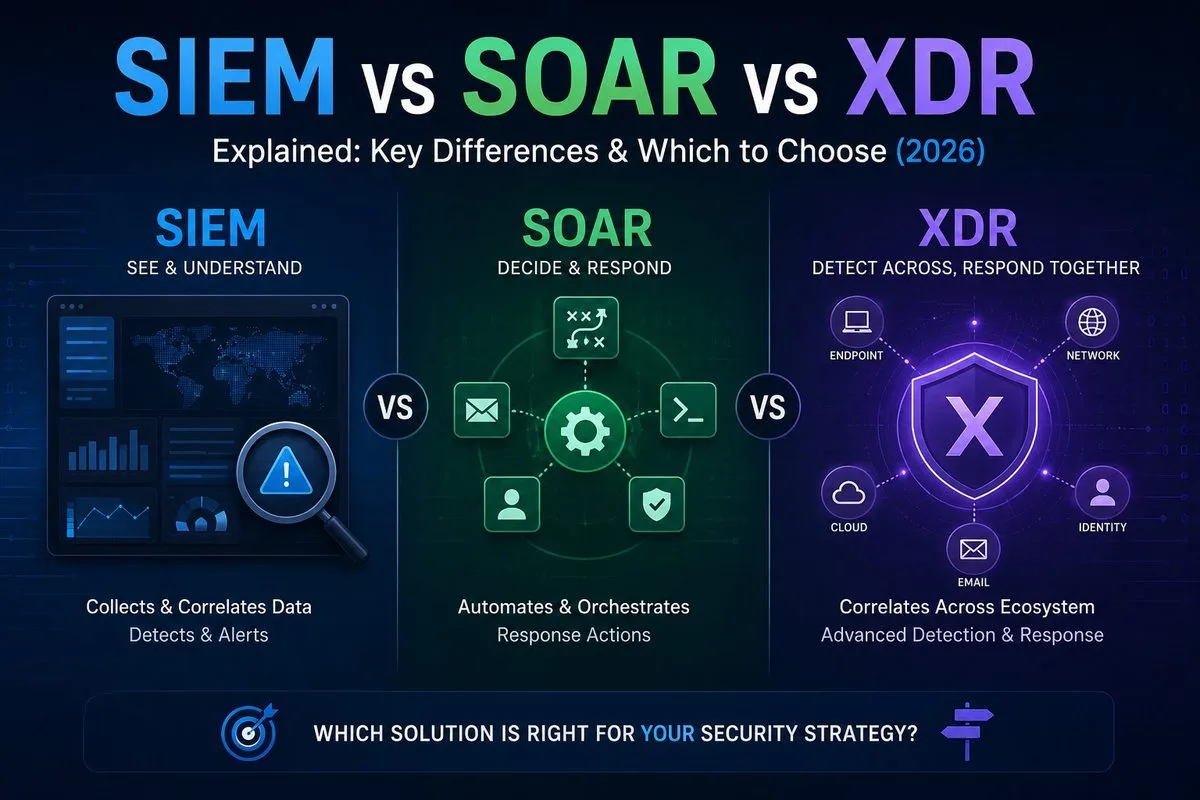
That’s the problem. SIEM, SOAR, and XDR are three different tools that try to solve different parts of it. They’re not interchangeable. They’re not even really competing. But because vendors market all three to the same buyers, they end up getting lumped together.
SIEM: The One That’s Been Around Forever
SIEM has been around since roughly 2005. That’s ancient in software terms. The core idea hasn’t changed much: pull logs from everything, store them centrally, write rules to detect suspicious patterns, and alert when those rules fire.
What SIEM Does Well
What SIEM does well is its breadth. You can feed it logs from literally anything. Your firewall, your cloud environment, your badge access system, and your custom internal application are all part of your security infrastructure. If it generates logs, SIEM can ingest them. That flexibility is genuinely valuable, especially for compliance purposes. PCI-DSS, HIPAA, and SOC 2 regulators want proof that you’re monitoring your environment, and SIEM was basically built to produce that proof.
Where It Gets Painful
SIEM is notoriously difficult to tune. Out of the box, the system fires alerts on everything. And I mean everything. Most organizations that deploy a SIEM without serious investment in tuning end up with thousands of alerts per day, the vast majority of which are meaningless. Login from a new device. Scheduled scan flagged as suspicious traffic. The service account performs the typical functions that service accounts are expected to perform.
Analysts start ignoring alerts. Not because they’re bad at their jobs, but because they wouldn’t get anything else done if they investigated every one. This is the alert fatigue problem, and it’s genuinely one of the more serious failure modes in enterprise security. The tools supposed to protect you end up training people to tune out warnings.
Why Everyone Still Uses It
Nothing else does what SIEM does at scale. Compliance requires it. The audit trail it creates is irreplaceable. And when you do have an incident to investigate, having months of centralized logs to search through is enormously valuable.
Popular options: Splunk, Microsoft Sentinel, IBM QRadar, Elastic SIEM. Sentinel has been gaining a lot of ground lately, mostly because it’s cloud-native and the pricing model is less punishing than Splunk for organizations already in the Microsoft ecosystem.
SOAR: Born Out of Frustration With SIEM
SOAR (Security Orchestration, Automation, and Response) basically exists because analysts got tired of doing the same thing over and over.
The Problem It Solves
Here’s a scenario that plays out in SOCs everywhere. SIEM fires an alert: suspicious login, possible credential stuffing. Analyst picks it up. Checks the IP against a threat intel feed. Looks up the account in Active Directory. Checks if there were any successful logins from that IP before. If the answer is yes, block the IP at the firewall. Creates a ticket. Emails the user. Logs everything. Closes the ticket.
That entire process takes about 20-30 minutes if the analyst is efficient. And that same alert fires dozens of times a week. Do the math.
How SOAR Fixes It
SOAR lets you turn that workflow into a playbook. Define it once: when this type of alert comes in, automatically check the IP against threat intel and look up the account; if it meets these criteria, then block and notify; otherwise, escalate to human review. The whole thing runs in seconds without anyone touching a keyboard.
For teams dealing with serious alert volumes, SOAR’s impact on mean time to respond can be dramatic. You can measure the alert types for which you have built playbooks in hours down to seconds.
The Catch Nobody Talks About
Building effective playbooks is challenging. It requires someone who understands both the security logic and the technical integration work. Your SOAR platform needs to connect to your SIEM, your firewall, your ticketing system, your directory services, and maybe your threat intelligence platform. Each integration takes work to build and more work to maintain as systems change. The demo looks magical. The implementation looks like an engineering project.
Furthermore, SOAR amplifies whatever your detection quality looks like. If your SIEM is firing bad alerts, SOAR will automate bad responses faster. Fix your detection first.
Popular options: Palo Alto XSOAR, Splunk SOAR, Tines, IBM QRadar SOAR.
XDR: The Newer Approach That Changes the Conversation
XDR (Extended Detection and Response) is newer, and it’s worth understanding because it’s genuinely different in approach, not just in name.
Start With EDR First
To understand XDR, start with EDR. Endpoint detection and response tools watch individual devices. Which processes run? Create or modify what files? What network connections does that machine make? Good EDR is excellent at catching malware executing on a laptop, an attacker moving between systems, and credentials being harvested at the host level. It’s focused, detailed, and useful.
The gap is that a real attack doesn’t stay in one place. An attacker sends a phishing email. A user clicks it. Something executes on their laptop. The attacker establishes persistence, moves toward other systems, accesses cloud storage, and starts exfiltrating data. That sequence crosses email, endpoint, network, and cloud. EDR only sees the endpoint part.
What XDR Actually Does
XDR stitches it all together. It collects telemetry natively from endpoints, networks, clouds, email, and identities, then correlates all of that into a single detection. Instead of three alerts that look like noise, you get one alert that says, “Here’s the attack chain, here’s what happened, here’s the user it centered on, and here’s what’s been affected.”
The quality difference matters. SIEM detection depends heavily on the correlation rules your team writes and maintains. XDR ships with vendor-maintained detection logic, updated continuously as new attack techniques emerge. For a team without dedicated SIEM engineers, that’s a huge practical advantage.
The Trade-off
XDR platforms work best when you standardize on that vendor’s products. Mix endpoint tools from one vendor, email from another, and networks from a third, and the cross-layer correlation starts to break down. You’re also more limited on custom log sources and compliance reporting compared to a mature SIEM.
Popular options: Microsoft Defender XDR, CrowdStrike Falcon, Palo Alto Cortex XDR, SentinelOne Singularity.
Comparing All Three
|
SIEM |
SOAR |
XDR |
|
|
Core job |
Log everything, detect patterns, alert |
Automate the response workflow |
Detect threats across environments natively |
|
Data sources |
Any log source you configure |
Alert feeds from detection tools |
Vendor’s own telemetry across layers |
|
Takes action automatically? |
No |
Yes |
Limited |
|
Good for compliance? |
Yes, built for it |
No |
Varies by vendor |
|
Setup difficulty |
High |
High |
Medium |
|
Best suited for |
Compliance-heavy orgs, broad visibility |
SOCs with high alert volumes |
Teams wanting strong detection with less tuning |
How They Actually Work Together
The most important thing to understand is that these tools aren’t competing for the same role. The best security stacks use all three in combination, each handling a different layer of the problem.
XDR handles high-fidelity detection across your environment. The alerts that come out of it tend to be high confidence and come with full context. SIEM catches everything XDR doesn’t cover, ingests your compliance-relevant logs, and provides the broad visibility layer. SOAR sits on top of both, running automated playbooks when either source fires an alert that meets the confidence threshold.
Think of it as a production line. XDR and SIEM are the sensors. SOAR is the factory floor that turns what the sensors find into action.
Not every team needs all three right now. If you’re a 30-person company with no dedicated security staff, standing up and maintaining a full SIEM is probably not the right use of your limited resources. A cloud-managed XDR or a managed detection and response service will give you better protection per dollar spent.
One thing worth mentioning: DDoS attacks are increasingly used alongside other intrusion techniques, sometimes as a distraction, sometimes as cover for something happening at the application layer. Understanding what a DDoS attack looks like helps your team read those SIEM alerts correctly when they come in. And catching the early signs before an attack is fully underway is the same principle that makes early detection valuable across all three tools.
A Real-World Example: What SolarWinds Taught the Industry
If you want to understand why the conversation shifted from SIEM toward XDR, the SolarWinds attack in 2020 is the clearest case study available.
What Happened
Attackers compromised the software build process at SolarWinds, a company whose IT monitoring software was used by thousands of organizations, including US government agencies. They inserted malicious code into a routine software update. When customers installed that update, the malware quietly activated, waited two weeks to avoid sandbox detection, and then started communicating with attacker-controlled servers.
The dwell time, meaning the period between initial compromise and detection, was somewhere between 8 and 14 months depending on the organization. Nearly a year of undetected access across some of the most security-conscious networks in the world.
Why SIEM Didn’t Catch It
The malicious traffic was designed to blend in. The attackers used legitimate SolarWinds infrastructure for their command-and-control communications, which meant the traffic looked exactly like normal software telemetry. SIEM correlation rules, which are written to catch known malicious patterns, had nothing to match against.
The organizations running SIEM were also dealing with the alert fatigue problem. Even if anomalous signals existed in the logs, and some did in hindsight, they didn’t rise above the noise level that would trigger serious investigation.
What This Means for XDR and SOAR
The post-incident analysis showed that indicators existed across multiple layers: subtle network communication patterns, unusual process behavior on endpoints, and identity anomalies in cloud environments. No single layer showed a clear smoking gun. But the cross-layer picture, had anyone been correlating it, revealed a different story.
This scenario is precisely the problem XDR was built to address. A well-configured XDR platform that correlates endpoint telemetry with network traffic and cloud identity behavior would have had a better chance of flagging the lateral movement as a connected attack chain rather than as scattered, individually explainable anomalies.
SolarWinds wasn’t a failure of any single tool. It was a failure of the overall architecture and the assumption that known-pattern detection is sufficient against sophisticated attackers. The industry is still recalibrating after the event.
Which One Should You Start With?
The answer depends entirely on where you are right now.
Small team, no dedicated security person: Start with XDR or a managed service. Don’t let anyone sell you a SIEM until you have someone who can maintain it. An untuned SIEM creates false confidence and alert fatigue at the same time.
Compliance requirements driving the decision (PCI, HIPAA, SOC 2): You need SIEM, full stop. Go cloud-native if you can. Microsoft Sentinel or Elastic SIEM is significantly more manageable than old on-premise deployments. Please ensure that it is stable and properly tuned before adding anything else.
SOC with analysts who are drowning: The detection is probably fine. The problem is response throughput. SOAR is where your ROI is. Map your most common alert types, build playbooks for the top ten, and track the time savings. That data usually justifies the investment clearly.
Enterprise-scale with a full security team: You’re probably using some combination already. The question is usually integration quality, not which tools to add.
Whatever your internal stack looks like, it doesn’t protect your public-facing infrastructure from volumetric attacks. When you manage web properties, DDoS protection becomes a distinct issue that is completely separate from the SIEM/SOAR/XDR discussion.
The Mistakes That Cost People the Most
Buying SOAR before fixing alert quality. Every time. The pitch is compelling, the demo is impressive, and then organizations automate noisy alerts and wonder why their automated responses are wrong. Sort out your detection first.
Assuming XDR replaces your SIEM. XDR vendors would love for you to believe this. For threat detection, XDR often wins. For compliance logging, audit trails, and custom data sources, SIEM still has no real substitute. They’re not competing for the same job.
Thinking a SIEM purchase is a project with an end date. It’s not. Tuning is ongoing. Your environment changes. New services get added. New attack techniques emerge. A SIEM that isn’t actively maintained drifts toward uselessness faster than people expect.
Skipping threat intelligence feeds. All three platforms improve significantly when fed external intelligence: known-bad IPs, malware hashes, and phishing infrastructure. It’s one of the highest-leverage integrations you can make, and people overlook it more often than they should.
Plain English Summary
SIEM: Collects logs from your entire environment, searches for patterns, and fires alerts. Compliance-critical. Needs serious tuning investment. Does nothing on its own when it finds something.
SOAR: Automates the response workflow. Takes the alerts your detection tools find and handles the repetitive parts automatically. This system is only useful if the alerts feeding it are of high quality.
XDR: Detects threats by correlating signals across endpoints, cloud, network, and email using vendor-maintained detection logic. Easier to operate than SIEM. Less flexible. Not designed for compliance logging.
EDR: The endpoint-only version of XDR. Most XDR platforms now include it.
Frequently Asked Questions
SIEM collects logs and generates alerts. That’s where it stops. SOAR takes those alerts and automates what happens next: the investigation steps, the blocking, the ticketing, the notifications. One detects it. The other responds. You generally need both.
No. SOAR needs a source of alerts to act on. Without SIEM (or XDR), it has nothing to automate. They’re built to work together, not compete.
For detecting threats across a modern environment, XDR is often more effective and easier to operate. For compliance logging, audit trails, and ingesting custom data sources, SIEM still wins. Most organizations end up using both, which is fine; they’re solving different problems.
EDR watches individual devices. XDR extends that to cover network traffic, cloud services, email, and identity, correlating everything together. If you’re evaluating today, XDR is almost always the better choice unless you have a specific reason to stay endpoint-focused.
EDR watches your devices. XDR watches your whole environment. SIEM records everything and tries to find the malicious stuff. SOAR acts when it finds the harmful stuff. In a well-built security stack, they’re all running together.
Microsoft Sentinel is for you if you’re already in the Microsoft ecosystem: the integration is tight and the pricing is more predictable than Splunk at scale. Use Splunk if you need maximum flexibility and have the engineering resources. Elastic if you want something more open and customizable. The right SIEM is the one your team will actually operate well, not the one with the best demo.