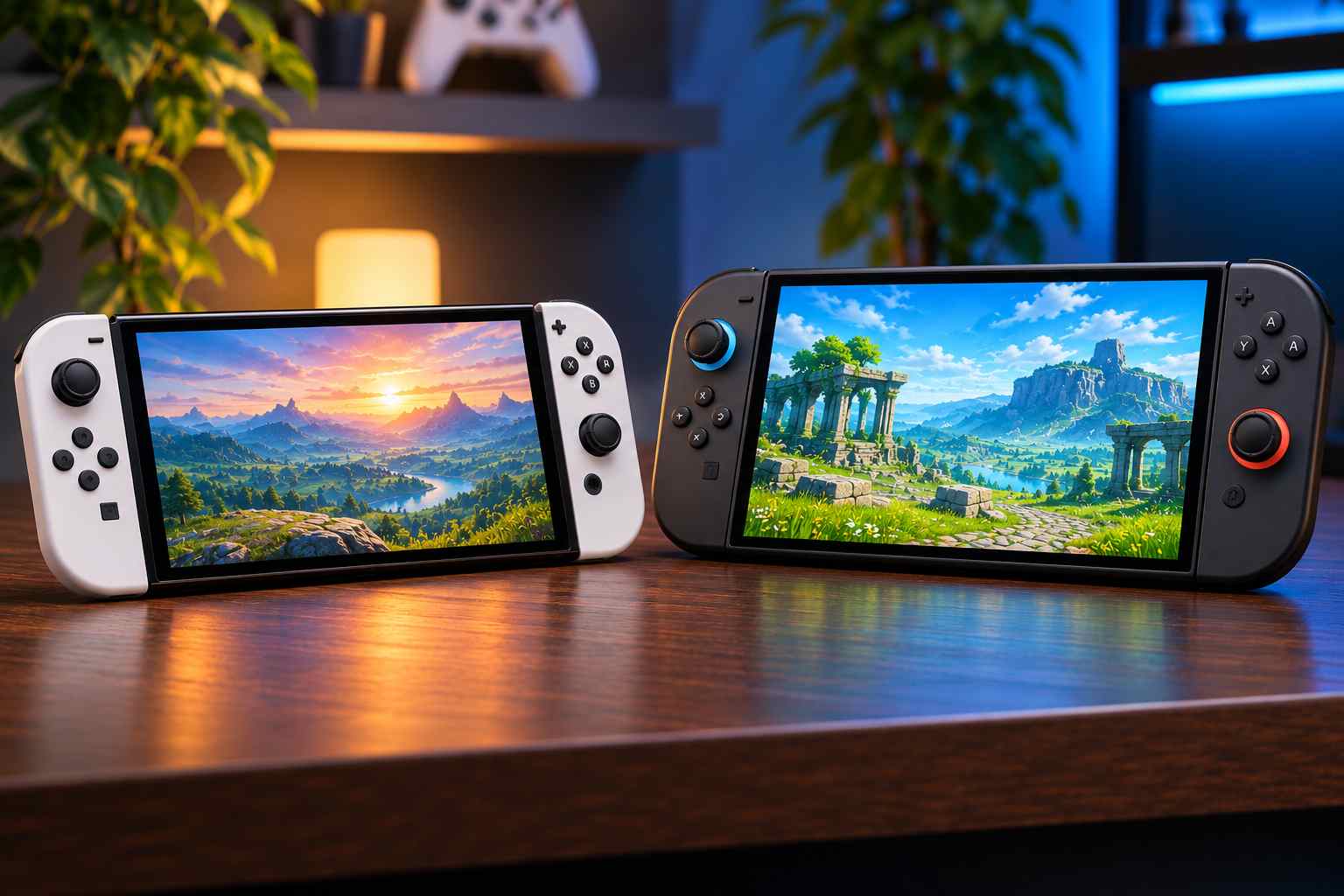
AI-generated illustration
Switch OLED vs Switch 2 is a closer fight than it was at launch. The OLED model costs $399.99 in the US. The Switch 2 went up to $499.99 on September 1, 2026. That leaves a $100 gap, and the answer isn’t obvious.
One thing first. I’m working from specs, price history and what reviewers measured, not from weeks with both consoles in my own bag. Where I give an opinion, I tell you why.
Switch 2 vs Switch OLED: Specs at a Glance
The Switch 2 has the bigger screen and the faster chip. The OLED costs less and runs longer away from a charger. One nine-category comparison landed in the same place: the Switch 2 took most rounds, the OLED took price and battery life.
|
Spec |
Switch 2 |
Switch OLED |
|
US price |
$499.99 |
$399.99 |
|
Screen |
7.9-inch LCD |
7-inch OLED |
|
Handheld resolution |
1080p |
720p |
|
Refresh rate |
Up to 120Hz |
60Hz |
|
HDR |
Yes |
No |
|
Docked output |
Up to 4K |
Up to 1080p |
|
Battery capacity |
5,220mAh |
4,310mAh |
|
Battery life |
2 to 6.5 hours |
4.5 to 9 hours |
|
Storage |
256GB |
64GB |
|
Docked output |
535g |
420g |
|
Dock USB-C ports |
2 |
1 |
Which Is Better, Switch OLED or Switch 2?
On hardware alone, the Switch 2 takes almost every round. Whether it’s worth $100 more is a different question, and it depends on what’s already on your shelf.
If you want Nintendo’s newest games, the Switch 2 is the only choice, because Switch 2 exclusives won’t run on any older model. If you mostly replay games you already own, the OLED still does the job.
Most upcoming Nintendo games still run on the original Switch, at least for now, which softens the pressure to upgrade. That could flip any month. It hasn’t yet.
How Do the Screens Compare?
The Switch 2 screen is larger and sharper. It measures 7.9 inches, runs at 1080p and refreshes at up to 120Hz. It also supports HDR and peaks around 400 nits. The OLED is 7 inches at 720p and 60Hz, with no HDR.
On paper that’s a clear win for the Switch 2. In a side-by-side screen test, though, the reviewer preferred the OLED panel for deeper color and contrast. Resolution isn’t everything, and true black still matters on a handheld you play in bed with the lights off.
I’d have bet on the Switch 2 panel winning outright, so that result surprised me. If you play in bed with the lights off, the OLED may look better to you. If sharp text and 120Hz motion matter more, go Switch 2.
Which Has Better Battery Life?
The Switch OLED lasts longer. Its battery gives roughly 4.5 to 9 hours. The Switch 2 manages about 2 to 6.5 hours from a bigger 5,220mAh cell.
The Switch 2 has more hardware to feed, especially that bigger, brighter display. A demanding game on the Switch 2 can drain it in two hours or so. That’s short, and I’d keep a power bank in the bag if I travelled with one.
The OLED’s range is the main reason it still makes sense for commuters and kids. You’ll plug it in less often. Nobody loves hunting for a charger on a train.
Does the Switch 2 Play Switch OLED Games?
Yes, most of them. Backward compatibility is what most upgraders worry about. The Switch 2 runs the large majority of original Switch games, and it takes physical cartridges and virtual game cards. Some titles won’t run, though, and a few need classic Joy-Con.
Nintendo handles older games in three ways:
- Standard compatibility: The game runs as it always did, with no changes, at no cost.
- Free updates: Nintendo patches some first-party games for smoother performance or better visuals.
- Switch 2 Editions: An enhanced version you pay for, or sometimes get through an online subscription.
Old games can run a little better on the Switch 2 even without a patch. Don’t expect miracles, though. Free updates don’t lift Switch 1 games to 1080p in handheld mode, so they stay at 720p.
Your old controllers carry over as well. The original Pro Controller and Joy-Con work on the Switch 2. The reverse isn’t true. The Switch 2 Pro Controller won’t work on a Switch OLED.
Storage is the other catch. The Switch 2 only takes microSD Express cards, so your old microSD card won’t work in it. My microSD card guide explains the difference.
How Much Faster Is the Switch 2 in Games?
Much faster. The Switch 2 uses an Nvidia chip with frame generation support, and it runs demanding games the OLED can’t handle natively. Cyberpunk 2077 is the best example. If you want a feel for that game before you buy anything, my Cyberpunk 2077 beginner’s guide covers the basics.
Docked, the Switch 2 outputs up to 4K, while the OLED tops out at 1080p. Metroid Prime 4: Beyond shows the gap. On the Switch 2 it runs at 4K and 60fps or 1080p and 120fps. The original Switch version runs at 720p and 60fps with dynamic resolution.
Some players said the difference looked smaller than expected, and load times were the biggest change. Not shocking. A well-made game still looks good at a lower resolution. Still, a 120fps mode on a big TV is hard to unsee.
What Does Each Console Cost Right Now?
The Switch OLED costs $399.99 in the US, and the Switch 2 costs $499.99. Nintendo raised the Switch 2 price by $50 on September 1, 2026. In the US, Canada and Europe, the older Switch models didn’t go up that day.
Don’t forget the extras. The Switch 2 Pro Controller costs $84.99, versus $79.99 for the original. And first-party Switch 2 games run higher, with Mario Kart World at $79. That adds up fast.
Consoles got pricier across the board this year, and my PS5 price breakdown shows the same pattern from Sony’s side.
Reviews written around launch quote older prices, like $349.99 for the OLED. Those numbers are stale. Always check the current figure before you trust any comparison.
Switch Lite vs Switch 2: Is the Lite Worth It?
The Switch Lite costs $229.99 and only works in handheld mode. It has a 5.5-inch 720p screen, built-in controls and no TV output. That’s a $270 gap from the Switch 2.
For a kid, a backup console or a pure commuter machine, that gap is big. For anyone who wants to play on a TV, the Lite is a dead end, because it can’t dock.
Think of the Lite as a cheap way to play the old library and nothing more. If you plan to play even one Switch 2 game, skip it.
Is the Original Switch 1 Worth Buying Over the Switch 2?
Not often. The standard Switch costs $339.99, which is only $160 under the Switch 2. It has an older 6.2-inch 720p LCD, and it plays docked at 1080p at best.
Switch 1 vs Switch 2 comes down to that $160. For that money you get a far better screen, faster performance, more storage (my console storage guide shows how much space you really need) and access to every new release. The standard Switch only makes sense if the budget is hard-capped, or if it’s a spare for the kids.
Who Should Buy What?
- Buy the Switch 2 if you want Nintendo’s newest games, heavy third-party ports or 4K docked play. If you like big open worlds, my list of the best RPG games shows what you’d be playing.
- Buy the Switch OLED if you mostly play existing Switch games, hate hunting for a charger and care more about handheld colour than sharpness.
- Buy the Switch Lite if it’s a cheap handheld for one person who never plays on a TV.
- Skip the standard Switch unless the price gap is the only thing that matters.
Frequently Asked Questions
Yes, if you want new Nintendo releases, a bigger 1080p screen and 4K docked output. If you mostly play old games, the money you save with the OLED is a fair trade.
Most of them, yes. A few original Switch games won’t run, so check Nintendo’s compatibility list before you trade in your old console.
No. The OLED lasts about 4.5 to 9 hours, and the Switch 2 about 2 to 6.5 hours.
Sharper, no. Richer color and contrast, often yes. The Switch 2 has the bigger, higher-resolution display with HDR, but the OLED panel looks deeper in side-by-side tests.
Yes. The original Pro Controller and Joy-Con work with the Switch 2. The Switch 2 Pro Controller doesn’t work with older Switch consoles.
Only as a cheap, handheld-only option. It can’t dock, and it can’t run Switch 2 exclusives.
So, Which One Should You Pick?
If I were buying today, I’d take the Switch 2 and grumble about the charger. The extra money buys a console that keeps getting games after the OLED stops.
But Nintendo already raised the OLED’s US price once, in 2025, and Japan’s went up again this year. If the cheaper one is your pick, I wouldn’t wait.