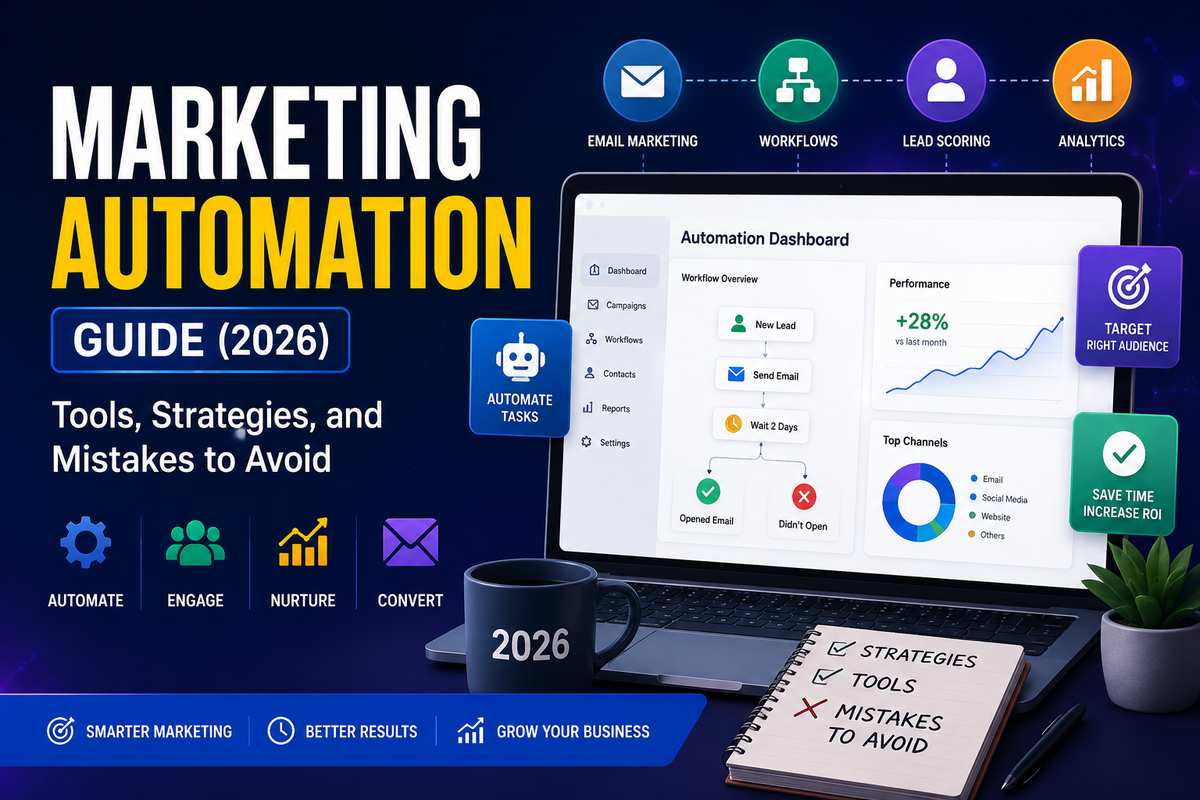

Marketing automation platforms appear in 82 percent of B2B martech stacks right now. That number keeps getting cited as proof that automation has gone mainstream. What it doesn’t tell you is how many of those installations are actually working versus how many are basically expensive contact databases with a few broken email sequences running in the background.
Honestly, the gap between companies that are getting real results from automation and companies that bought a platform and called it done is pretty wide. Wider than most vendor case studies would suggest. The technology isn’t usually the problem. What goes wrong is almost always one of three things: the wrong platform for the actual use case, workflows that got built once and never touched again, or a fundamental misalignment between what marketing considers a qualified lead and what sales actually wants to work.
This guide covers what marketing automation actually does, how it differs from CRM, which processes to automate first, the tools worth considering in 2026 by company size and use case, common mistakes that kill ROI before results have a chance to show up, and how it applies across industries like insurance, healthcare, law firms, and real estate.
What Is Marketing Automation?
Here’s the simplest way to think about it. Marketing automation is software that does the repetitive parts of marketing so your team doesn’t have to do them manually every single time. Nurturing leads through a long sales cycle, delivering the right content to the right person at the right stage, scoring engagement, triggering follow-ups. All of that happening automatically, in the background, whether someone on the team is watching or not.
The classic example is a prospect downloading a whitepaper from your website. Without automation, that lead sits in a spreadsheet until someone remembers to follow up, let’s say a few days later when the interest has already gone cold. With automation, that download triggers a welcome sequence within minutes, assigns a lead score based on the prospect’s company size and job title, notifies the relevant sales rep, and starts a nurture flow built around what that person is likely researching. No manual input. No dropped balls.
The technology tracks three things in parallel. Prospect behavior across every channel, website visits, email opens, content downloads, ad clicks. Engagement patterns and demographic signals that determine lead quality. And campaign execution timing, making sure the right message goes out at the right moment without anyone having to manually schedule it.
CRM vs Marketing Automation Explained
This one causes more confusion than it probably should. CRM and marketing automation are not the same thing. They’re not even really competing categories. The confusion comes from platforms like HubSpot bundling both into a single product, which makes them look interchangeable when they’re not.
A CRM is built for sales. It manages contacts, tracks deals, records every call and email the sales team logs, and keeps a record of where each prospect is in the pipeline. It’s the source of truth for revenue. Marketing automation is built for marketing. It handles top and middle of funnel, attracting prospects, nurturing them with content over time, scoring their engagement, and eventually handing off qualified leads to sales with full context about what that person did.
Sure, they overlap in places. There’s no denying that. But using a CRM to do marketing automation is like using a spreadsheet to manage a project. It works until it doesn’t, and then it’s very hard to untangle. They’re designed to feed each other, not replace each other. A marketing automation platform running without CRM integration creates data gaps that cause misalignment between sales and marketing almost immediately.
Which Marketing Processes to Automate First
Most teams make the same mistake here. They try to automate everything at once, map out 15 different customer journeys in week one, and end up with a platform full of half-built workflows that nobody trusts. Three months later, someone turns it all off and goes back to sending emails manually.
Start narrower and start with the things that are repetitive, currently falling through the cracks, and don’t require complex logic to build.
Start with Lead Nurture and Scoring
Lead nurture sequences are the first thing to get running. When someone downloads a piece of content or fills out a form, they’ve shown interest. Most companies let that interest go cold because nobody follows up consistently, let’s say within the first week of contact before the prospect has moved on to a competitor’s content. An automated welcome sequence and follow-up nurture flow keeps that engagement alive without anyone manually sending individual emails.
Lead scoring should come next, especially in B2B where sales teams regularly get buried in leads of varying quality. Basic scoring rules, points for email opens, pricing page visits, webinar attendance, company size, and job title, give sales a signal about where to focus. Even a rough scoring model beats treating every inbound lead the same. For more on how lead scoring connects to the content strategy that feeds it, our content marketing guide covers how content types map to different stages of the buyer journey.
Then Build the Supporting Workflows
Marketing workflow automation around internal routing is another early win that gets underestimated. Sending leads to the right sales rep based on territory or product interest. Triggering notifications when a high-score prospect visits a key page. Updating CRM properties automatically when someone takes an action. Low complexity to build, high immediate impact on manual work.
Re-engagement campaigns for cold leads are worth automating early because nobody runs them manually with any consistency. A sequence that fires automatically after 90 days of inactivity, offers something relevant, and suppresses non-responders keeps the database healthier and deliverability intact.
Inbound marketing automation around content segmentation starts to pay off once the first four are running. Splitting new contacts by how they arrived, what they engaged with, and what that behavior implies about their buying stage makes content nurture much more targeted than a blanket newsletter going to everyone.
Marketing Automation Platform Comparison (2026)
Picking the right platform is not about finding the one with the most features. It’s about matching the platform to what the program actually needs right now, with room to grow into what it needs in 12 months. Getting that wrong means paying for capability the team will never use, or outgrowing a tool that fit perfectly at launch.
Three variables matter most: company size, how mature the underlying data is, and how complex the buyer journey actually is. Everything else is secondary.
HubSpot
HubSpot is the default choice for SMB and mid-market B2B teams who want CRM and marketing automation in one place without needing a dedicated marketing operations person to run it. The workflow builder is intuitive enough that a non-technical marketer can build and modify sequences without engineering support. Email tools are solid. CRM is native, so sales and marketing are looking at the same contact data without any integration work.
The ceiling is real though. HubSpot Professional starts at $800 per month, Enterprise at $3,600. For teams running sophisticated multi-stakeholder ABM journeys or complex revenue attribution across multiple business units, the platform starts to feel constrained. For most companies under 500 employees with a reasonably standard B2B inbound motion, it’s usually the right call. Above that threshold, the limitations become noticeable.
The honest answer on the hubspot competitors crm marketing automation platform comparison is that the right choice depends heavily on what CRM the sales team already uses, how technically capable the marketing ops function is, and how complex the actual buyer journey is. There’s no universal winner.
ActiveCampaign
ActiveCampaign sits in the middle ground between Mailchimp-level simplicity and HubSpot-level capability. Strong email automation, solid behavioral triggering, and a visual workflow builder that marketers can use without specialist support. Pricing is meaningfully lower than HubSpot for equivalent contact counts, which matters for growth-stage companies watching budget carefully.
The CRM functionality is less mature than HubSpot’s native CRM. That gap matters if tight sales and marketing alignment is a priority. For B2B teams that want serious automation capability without the HubSpot price tag, and are willing to use a separate CRM, ActiveCampaign is the most commonly recommended option. For anything with a significant e-commerce component, Klaviyo should be in the evaluation alongside it.
Marketo Engage (Adobe)
Marketo is enterprise territory. It’s built for large B2B organizations with dedicated RevOps and marketing operations teams, complex multi-stakeholder sales cycles, and the internal resources to configure and maintain a sophisticated platform. Lead scoring depth, ABM capabilities, attribution modeling, and Salesforce integration are all genuinely more capable than HubSpot or ActiveCampaign at the top end.
The trade-off is that Marketo isn’t something a small team picks up and runs in a reasonable timeframe. It assumes significant technical sophistication and dedicated operational bandwidth. Pricing starts at $895 per month. For the enterprise B2B organizations it’s designed for, the depth is justified. For everyone else, the overhead isn’t.
Microsoft Dynamics Marketing Automation
Microsoft Dynamics marketing automation through Dynamics 365 Marketing is the obvious choice for organizations already standardized on the Microsoft 365 and Azure ecosystem. The native CRM integration is the main selling point. The platform has improved considerably over the last few years and handles campaign management, customer journeys, lead scoring, and event management well enough for most enterprise use cases.
It’s worth evaluating specifically in the context of the broader Microsoft stack though. Compared to HubSpot or Marketo on standalone marketing automation capability, Dynamics rarely wins. Compared to the integration value it provides for Microsoft-first organizations, it often makes a lot of sense.
Open Source Marketing Automation
Open source options, primarily Mautic, make sense for organizations that have technical resources to manage self-hosted infrastructure and genuinely need complete data control. The licensing cost is lower than SaaS alternatives but the total cost of ownership, hosting, maintenance, security, and the engineering time required to manage it, often approaches commercial platform pricing at any serious scale.
Mautic covers the core workflows: email campaigns, lead scoring, landing pages, CRM integrations. For organizations with strong technical teams, data sovereignty requirements, or very large contact databases where per-contact SaaS pricing becomes prohibitive, it’s worth evaluating seriously. For everyone else, the SaaS options save more time than the cost difference justifies.
Ruiyun vs HubSpot
The ruiyun vs hubspot marketing automation comparison comes up specifically for teams evaluating Chinese-market focused platforms. Ruiyun is built around WeChat and Chinese social channels, which HubSpot doesn’t natively support. If there’s significant marketing activity in China, that comparison is worth making. For markets outside China, it’s not a relevant evaluation.
Marketing Automation by Industry
The workflows that drive value in marketing automation look quite different across industries, in terms of the specific use cases that matter most, the compliance requirements involved, and the typical length of the buyer journey being automated.
Healthcare Marketing Automation
Healthcare marketing automation runs under HIPAA compliance requirements that aren’t optional. The platform and every workflow built on it needs to handle patient data appropriately before anything else gets considered. The automation use cases that make sense center on appointment reminders, post-visit follow-up sequences, and educational content flows for specific conditions or treatment paths, let’s say content that helps a patient understand their options before their next consultation rather than promotional material pushing a service.
B2C patient acquisition automation and B2B automation around selling services to hospital systems or medical practices need to be treated as separate programs with separate compliance reviews. Mixing them creates risk.
Insurance Marketing Automation
Insurance agency automation tends to center on three things. Lead nurture for prospects who requested quotes but didn’t convert. Renewal reminders timed to policy expiration dates. And cross-sell sequences for existing customers who might qualify for additional coverage. The compliance requirements for insurance marketing vary by state and product type and need to be built into every workflow from the start, not reviewed after the campaign is already running.
Law Firm Marketing Automation
Law firm marketing automation has grown considerably as practices have become more willing to treat business development as a real function rather than an afterthought. The workflows that make sense are content-based: follow-up sequences for people who downloaded a guide, attended a webinar, or requested an initial consultation. Attorney advertising rules mean every automated communication needs a compliance review before launching. That review process needs to be factored into the implementation timeline, not discovered after the first campaign goes out.
Marketing Automation for Contractors and Manufacturing
Contractor and manufacturing automation deals with longer lead nurture cycles because the buying process involves more stakeholders and longer timelines than most B2C contexts. Content sequences built around specific project types, material categories, or industry verticals, paired with lead scoring that surfaces contacts actively researching, outperform generic promotional email blasts in these contexts by a meaningful margin.
Marketing Automation for Real Estate
Real estate automation covers lead routing from listing inquiries to specific agents, property alert sequences based on saved search criteria, and long-term nurture for prospects who are researching but not ready to transact. The challenge unique to real estate is the unpredictable gap between initial inquiry and actual transaction. Nurture sequences need to deliver consistent value over months without becoming noise, otherwise contacts unsubscribe before they’re ever ready to move.
Retail and E-commerce Marketing Automation
Retail and e-commerce automation shares the same core workflows with email marketing: abandoned cart, post-purchase sequences, browse abandonment, win-back campaigns for lapsed customers. The difference from standalone email marketing is that a full automation platform connects product data, purchase history, browsing behavior, and customer lifetime value into a single view, which allows for segmentation significantly more targeted than email alone can produce.
Common Mistakes in Marketing Automation
The biggest challenges in marketing automation in 2026 consistently trace back to the same problems. Not new ones.
Mistake 1: Building It and Forgetting It
Building it and forgetting it is the most common mistake across every company size. Workflows set up 18 months ago, with different buyer journeys, different offers, and a different team structure in mind, keep running because nobody scheduled a review. Stale sequences with outdated content, broken integrations nobody caught, lead scoring models that no longer reflect how qualified leads actually behave. It doesn’t fail dramatically. It just quietly stops working while the team assumes everything is fine.
Mistake 2: Ignoring Data Quality
Ignoring data quality makes everything else worse. Automation amplifies whatever is in the database. A dirty CRM with duplicate contacts, incorrect industry fields, and missing company data means automated personalization fails constantly. Let’s say a nurture sequence referencing a prospect’s industry gets sent with the wrong industry populated to hundreds of contacts automatically because nobody audited the data before the workflow launched. Attribution and reporting become unreliable when the underlying data isn’t clean.
Mistake 3: Automating Too Much Too Fast
Automating too many things at once is how teams end up with a platform full of half-built workflows they don’t trust. Starting with two or three high-impact flows, getting them right, and building from there consistently outperforms trying to automate every possible journey in the first month. The platform gets a fair chance to prove its value instead of being blamed for problems caused by configuration complexity.
Mistake 4: Misaligning Sales and Marketing
Misaligning on lead handoff is where a significant portion of automation ROI gets lost. Lead scoring models that marketing built without sales input create friction the moment scored leads arrive in the CRM. Sales ignores the score. The automation investment stops having downstream impact. As 6sense’s B2B marketing automation guide notes, the architecture choice between lead-based inbound and account-based outbound platforms matters as much as which specific tool gets selected.
For a practical breakdown of how to compare platforms before committing to one, Improvado’s marketing automation tools comparison covers HubSpot, Klaviyo, ActiveCampaign, Customer.io, and Brevo with actual pricing and workflow capability details.
Marketing Automation for Agencies and Freelancers
Marketing Automation Agency
A marketing automation agency helps companies implement, configure, and manage their platforms on an ongoing basis. Services range from initial setup and workflow design to ongoing optimization, reporting, and campaign management. Implementation work typically starts with an audit of the existing stack and buyer journey mapping before any configuration begins, because building workflows before understanding the current state usually means rebuilding them three months later.
Marketing automation implementation services make sense for companies that have chosen a platform but don’t have internal marketing operations capacity to build it out properly. A poorly configured automation platform is often more damaging than no platform at all. It creates the appearance of activity while leads fall through workflows nobody noticed were broken.
Freelance Marketing Automation
Freelance marketing automation has grown significantly as a category. Specialists typically focus on one or two platforms, most commonly HubSpot, ActiveCampaign, or Marketo, and handle implementation, workflow builds, and ongoing management for companies that don’t need or can’t justify a full-time hire. The marketing automation manager job market in 2026 remains active, particularly for HubSpot and Marketo-certified practitioners who can demonstrate campaign results rather than just platform knowledge.
White Label and Channel Marketing Automation
Through channel marketing automation covers vendor-managed programs where marketing materials and automated sequences are provided to resellers or channel partners who execute them under their own branding. Direct mail marketing automation and WhatsApp marketing automation extend the same multi-channel principle to different delivery channels.
Marketing automation consulting typically covers strategy and platform selection rather than hands-on configuration, helping organizations decide what to automate, which platform fits their context, and how to structure marketing operations around it. The distinction from implementation agencies is that consultants focus on the strategic layer rather than the technical build.
Marketing Automation Trends in 2026
The gap between platforms that have genuinely integrated AI into their execution layer and platforms that are wrapping AI language around existing features has become pretty obvious to anyone paying close attention. Klaviyo added agentic marketing features in 2026 that suggest and actually execute optimizations, send-time adjustments, and A/B test launches without waiting for a human to approve each one. HubSpot reported 99 percent acceleration in inbound lead volume in pilot implementations of their AI tools, though that figure comes from their own data. The practical question for any platform evaluation right now is not whether the vendor has AI features. It’s whether the platform executes autonomously or just surfaces recommendations that still require human action.
Account-based marketing automation has matured enough that enterprise B2B teams are running buying group journeys rather than individual lead nurture sequences. That requires platforms that can model engagement at the account level across multiple contacts simultaneously, not just track individual behavior. 6sense, Demandbase, and Salesforce Marketing Cloud are the platforms most commonly deployed for this.
The broader direction for B2B tech marketing automation solutions is toward a revenue operations stack rather than a standalone marketing platform. The automation tool is one layer. Revenue intelligence tools that connect marketing activity to pipeline and closed revenue are increasingly treated as a required second layer for mid-market and enterprise teams that want to demonstrate marketing’s contribution to revenue outcomes.
For more context on how automation fits into a broader go-to-market approach, our B2B marketing guide covers demand generation strategy and how automation connects to the wider picture.
Frequently Asked Questions
It’s software that runs marketing tasks automatically based on triggers and rules you define. Someone visits your pricing page, downloads a guide, or goes 90 days without engaging, and the system responds with the appropriate next step without anyone manually deciding to do it.
CRM is for sales: contacts, deals, pipeline. Marketing automation is for marketing: lead nurturing, behavioral tracking, campaign execution. They’re built to work together. Using one to replace the other creates gaps that hurt both functions.
Lead nurture sequences for new contacts, basic lead scoring, and internal routing. Those three have the most immediate impact and the lowest configuration complexity. Get them working properly before building anything else.
Building workflows once and never reviewing them. Ignoring data quality in the CRM before automating personalization. Trying to automate everything at once. And misaligning with sales on what a qualified lead actually looks like before the first lead gets passed.
HubSpot Starter or ActiveCampaign for most small businesses. HubSpot bundles CRM and automation which simplifies the stack. ActiveCampaign gives more automation depth at lower price points if budget is the constraint and you’re okay managing CRM separately.