Image: Technwz / Kimi logo: Moonshot AI
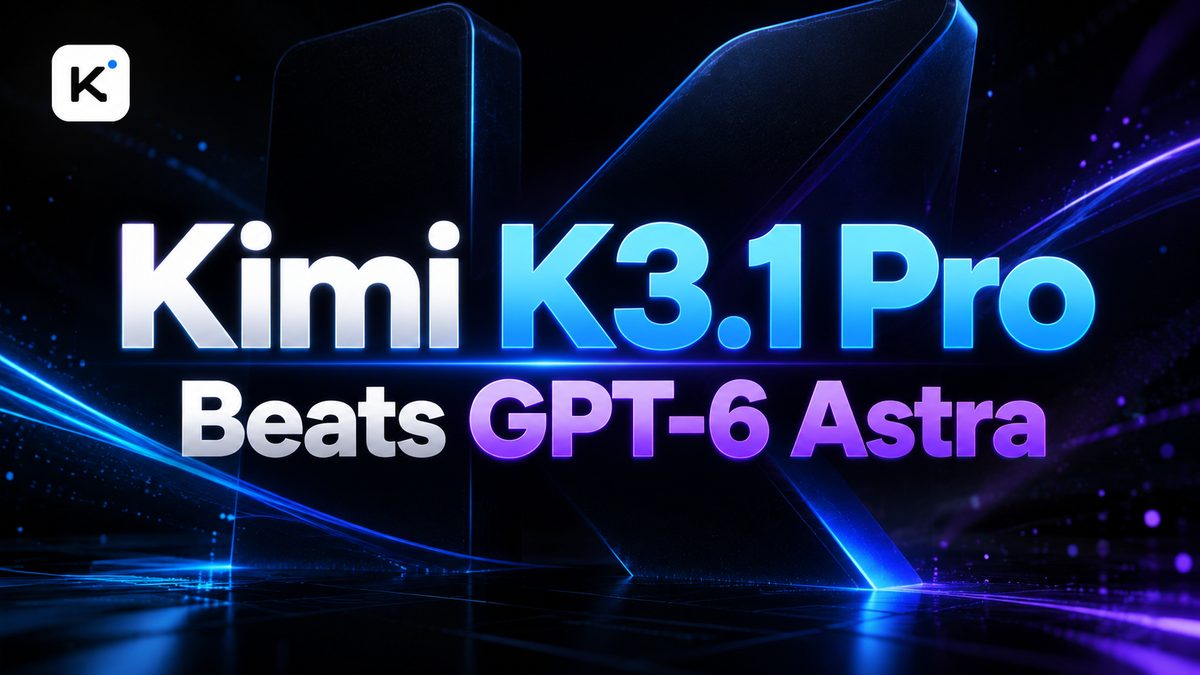
Moonshot AI has launched Kimi K3.1 Pro, an upgraded AI model that it says scores 65.7% on the Terminal-Bench 4.0 coding benchmark, ahead of OpenAI’s GPT-6 Astra at 58.2%. The model went live on October 23, 2026, and Moonshot released the full model weights on November 4, and anyone can now download them from Hugging Face. The model is a 2.8 trillion parameter mixture-of-experts design with about 104 billion active parameters per token, and it ships under a custom Kimi license with some commercial limits.
That combination is what makes this launch stand out. Open-weight models usually trail the best closed models by a wide margin. On Moonshot’s own numbers, this one comes close to the top.
What’s new in Kimi K3.1 Pro
The new model is not built from scratch. It is a heavily retrained version of Kimi K3, built with much more post-training compute. Moonshot says it scaled its reinforcement learning across hundreds of task areas.
The key upgrades, according to Moonshot:
- 1 million token context window: enough to work through very large codebases or long documents in one go.
- Stronger long-running coding: its internal long-horizon coding score rose from 55.95% to 61.2%.
- Game and 3D work: Moonshot highlights coding for Unity, Unreal Engine, and Godot, plus scripted 3D modeling in Blender and CAD tools. A new 3D Make feature on kimi.ai lets users download models for 3D printing.
- Fewer made-up answers: on Moonshot’s own hard hallucination test, the rate of false claims fell from 23.4% with K3 to 8.3%. Moonshot says that test is designed to provoke errors, so everyday rates should be lower.
Kimi K3.1 Pro benchmarks vs GPT-6 Astra and Claude Opus 5.5
Here is how the model stacks up on the benchmarks where Moonshot published rival scores:
|
Benchmark |
Kimi K3.1 Pro |
GPT-6 Astra |
Claude Opus 5.5 |
|
Terminal-Bench 4.0 (coding, higher is better) |
65.7% |
58.2% |
66.4% |
|
BenchCAD with tools (3D, higher is better) |
92.7 |
95.9 |
96.2 |
|
Hallucination, no tools (lower is better) |
5.4 |
4.2 |
6.8 |
The picture is mixed but strong. It clearly beats GPT-6 Astra on Terminal-Bench and lands just behind Claude Opus 5.5. It trails both rivals on 3D modeling, and GPT-6 Astra still makes fewer factual errors.
Keep in mind that these are Moonshot’s own figures. Several benchmarks are internal, and rival scores come from other companies’ reports or third-party leaderboards. Independent tester Artificial Analysis has since run its own numbers: K3.1 Pro scores 55 on its Intelligence Index, up from 44 for Kimi K3 and fourth overall. Artificial Analysis also measured 67% on Terminal-Bench 4.0, ahead of Sonnet 5.5 at 64%, and put K3.1 Pro second on its Cyber Index at 64%, the highest score for any publicly available model, according to Latent Space. Separately, Vals.ai ranks it eighth of 27 on the Vals Index at 62.52%, the top open-weights model there. Claude Opus 5.5 still leads on Humanity’s Last Exam. Early independent results look strong, but fuller testing will matter once the weights are out.
A faster Highspeed version
Moonshot also released K3.1 Pro Highspeed, which it says runs two to three times faster than the standard model. It is aimed at chat and other tasks where quick replies matter more than maximum quality.
Where you can use Kimi K3.1 Pro
The model is available now on:
- Kimi.ai and the Kimi apps for iOS, Android, and HarmonyOS
- Kimi Work, the desktop app for Windows and Apple silicon Macs (version 3.1.0 or later)
- Kimi Code, using the
/modelcommand - The Kimi API, as
kimi-k3.1-proandkimi-k3.1-pro-highspeed, with a zero data retention option
Business users will need an admin to switch it on, since it is off by default for organizations. Demand caused trouble in the first days after launch. Moonshot apologized for rate limits and unnecessary quota use on K3.1 Pro subscription plans and said the problem was its own. Every paid subscriber gets a one-time reset that restores 25% of their monthly quota, about a week of use. Moonshot also cut unnecessary sub-agent calls and shortened outputs. Moonshot did not publish pricing in its announcement, but its API listing on OpenRouter shows $2 per million input tokens and $10 per million output tokens, with the Highspeed endpoint at $4 and $20. Cached input costs $0.20 per million tokens, and the standard rates are about a third lower than Kimi K3’s $3 and $15, according to Tech Times.
Toned down for hacking
Moonshot says it removed cyberattack-related training data from the open-weight release on purpose. A version trained without those limits scored 90.5 on its internal hacking benchmark, while the released model scored 81.0.
The company says it does not want open weights to push the limits of what AI can do in cyberattacks. It says the model’s hacking skills sit behind closed frontier models that have been public for at least three months. Independent testing paints a stronger picture, though: Artificial Analysis ranks K3.1 Pro second on its Cyber Index, the highest of any publicly available model, so it is unclear how much of that gap remains in the version people can use today.
Why it matters
If the open weights arrive on schedule, developers will be able to run and fine-tune Kimi K3.1 Pro on their own hardware or cloud, and it rivals GPT-6 Astra on coding. That puts more pressure on OpenAI, Anthropic, and Google and gives startups a strong option; they don’t have to rent. The real test is now underway, since outside researchers can check Moonshot’s claims for themselves.
Source: Moonshot AI: Kimi K3.1 Pro announcement, VentureBeat, OpenRouter