
There’s no single best hardware firewall. That’s the trap with this category. It’s tempting to want one clean answer, but the right pick depends entirely on whatever network you’re actually running. A home office with a handful of smart devices needs something completely different than a data center handling customer records.
I went through the current lineup across home, small business, and enterprise tiers. What follows are the strongest picks in each. Prices and specs shift constantly in this space, so treat these as a solid starting point rather than gospel.
What Makes a Hardware Firewall Worth Buying
A hardware-based firewall does one thing a router’s built-in protection can’t. It inspects traffic with dedicated processing power instead of borrowing cycles from whatever else the device is doing. That matters more than people think. Deep packet inspection, intrusion prevention, and VPN termination all eat into performance. A router trying to juggle Wi-Fi, DHCP, and security at once usually cuts corners somewhere.
Before buying anything, I’d weigh four things. Throughput matters most, since a firewall that chokes your internet speed defeats the purpose the moment security features get switched on. Subscription costs matter almost as much. Plenty of vendors sell the hardware cheap and make the real money on annual threat-intelligence licenses. Management complexity is the third factor. It varies wildly, from an app you tap through in ten minutes to a command-line interface that practically needs a certification. That complexity gap is part of why comparing a SIEM vs SOAR vs XDR setup gets confusing fast, and firewall management tiers follow the same pattern. Firmware support life rounds it out. An end-of-life firewall running unpatched software is arguably worse than no dedicated firewall at all.
Best Hardware Firewalls for Home Networks
Home setups have changed a lot. It’s not just a laptop and a phone anymore. It’s cameras, smart speakers, a couple of streaming boxes, and probably a kid’s tablet that downloads whatever it wants. Finding the best home firewall for that mix means balancing ease of use against how much control you actually want.
Firewalla Gold SE
This is my top pick for most homes. It pushes roughly 2 Gbps of inspected throughput. It runs entirely through a phone app and doesn’t charge a subscription for its core features. That last part matters a lot over a three-year ownership window. Setup takes maybe twenty minutes. The per-device visibility is genuinely useful, not just a marketing bullet point.
Ubiquiti UDR7
If you’re replacing an aging router anyway, this one’s hard to beat on value. It bundles a WiFi 7 router, a small switch, and real traffic inspection into one unit for around $279. The tradeoff is that its security controls are less granular than Firewalla’s. Its WiFi coverage also suits an apartment better than a sprawling house.
Netgate 4200 MAX
This is the pick for people who want full control and don’t mind a steeper learning curve. It runs pfSense+ and gives you rule-by-rule customization. Think enterprise-grade tinkering, just scaled down to home size. Not for someone who wants to set it and forget it.
Best Hardware Firewalls for Small Businesses
The best firewall for a small business needs to survive without a dedicated IT department babysitting it daily. That rules out a lot of enterprise gear right out of the gate, even the genuinely excellent stuff. If you’re hunting for the best small business firewall on a tight budget, start with the three below before looking anywhere else.
Fortinet FortiGate 60F
This has become the default recommendation among resellers this year, and for good reason. It handles offices of ten to fifty users comfortably. FortiGuard’s AI-based threat detection punches well above the hardware’s price point. The FortiGate 40F is the smaller sibling if your headcount is lower.
SonicWall TZ370
SonicWall’s cloud dashboard is the real selling point here. A business firewall managed from a browser, with no command-line knowledge required, is exactly what an office without a full-time network admin needs. Real-Time Deep Memory Inspection also catches memory-based malware that pure signature matching would miss entirely.
Cisco Meraki MX67
Multi-site businesses gravitate toward Meraki for a reason. Managing several office locations from one cloud console beats logging into five separate appliances every time a policy needs updating. It costs more over time thanks to the licensing model. For a growing retail chain or franchise, that overhead usually pays for itself.
A quick industry note worth mentioning here: Forbes Business Council members increasingly rank dedicated network security hardware among their top cybersecurity investments, right alongside employee training and breach response planning. That tracks with what I’m seeing across every SMB IT forum I’ve read through this year.
Best Hardware Firewalls for Enterprise and Data Centers
An enterprise firewall lives a harder life than anything on the home or SMB list. Multiple sites, hybrid cloud connections, and thousands of simultaneous sessions push these appliances to their actual limits, not just their spec sheets.
Palo Alto PA-440 and PA-Series
Palo Alto still sets the bar for enterprise security depth. App-ID and User-ID give admins visibility most competitors still can’t fully match. Panorama’s centralized management scales cleanly across dozens of sites. It’s a premium product with a premium price tag to match.
Fortinet FortiGate 100F
Built on Fortinet’s custom ASIC architecture, this model delivers throughput numbers that genuinely outperform similarly priced competitors. Among top-rated data center firewalls, it’s one of the few that balances raw performance with a price small-to-midsize enterprises can actually justify.
Cisco Secure Firewall 3100 Series
For organizations already running Cisco switches and routers, this integrates cleanly instead of bolting on as a separate ecosystem to manage. Deep packet inspection and URL filtering come standard. The familiarity factor alone saves a lot of onboarding time for existing Cisco shops.
Testing methodology matters here too. TechRadar’s own firewall testing looks at detection accuracy, quarantine speed, and performance impact side by side, which is roughly the same framework worth applying to hardware appliances, not just consumer software.
Firewall Brands Worth Knowing
Beyond the specific models above, a handful of firewall brands show up again and again across every tier of this market. Fortinet, Palo Alto Networks, Cisco, SonicWall, Check Point, and WatchGuard dominate the vendor landscape. Each one leans into a different strength. Fortinet wins on price-to-performance. Palo Alto leads on depth and visibility. Cisco wins when you’re already inside its ecosystem. Check Point commands a premium but delivers strong preemptive threat prevention for regulated industries like banking and healthcare.
Newer names are carving out space too. Firewalla and Ubiquiti have reshaped what’s realistic for home and prosumer buyers. TP-Link’s Omada line is doing something similar at the budget end of small business. None of these smaller players threaten the enterprise giants yet, but the gap has narrowed noticeably over the past couple of years. A well-configured firewall also plays a role beyond intrusion prevention. It’s one of your first lines of defense during a DDoS attack against a business network, even if it’s not the whole solution on its own.
My Picks
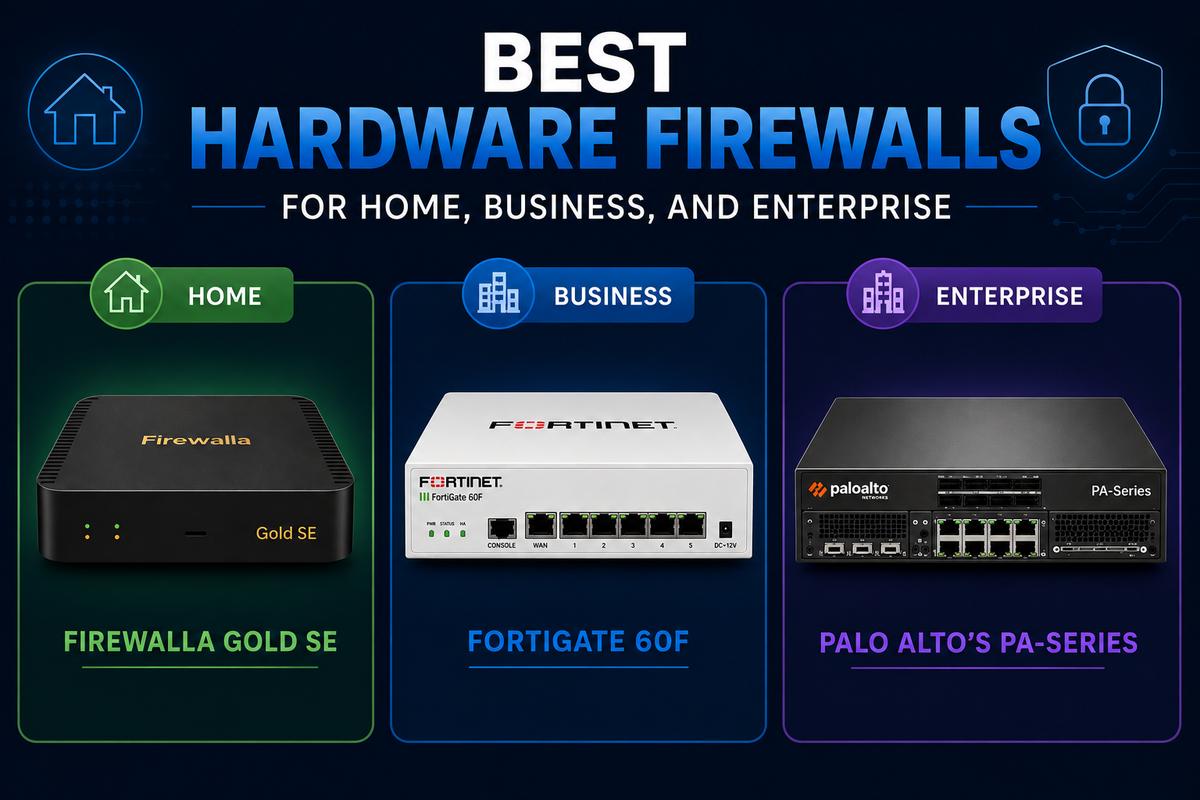
If I had to boil this whole list down: Firewalla Gold SE for most home users, FortiGate 60F for most small businesses, and Palo Alto’s PA-Series for most enterprises unless budget forces a Fortinet alternative.
None of that means the other options here are wrong choices. Network security hardware isn’t one-size-fits-all. The “best” pick genuinely depends on team size, budget, and how much hands-on management your team can realistically commit to. Buy for where your network is headed in three years, not just where it sits today. Hardware upgrade cycles are slow, and nobody wants to relearn a whole new interface eighteen months after finally getting comfortable with the last one.