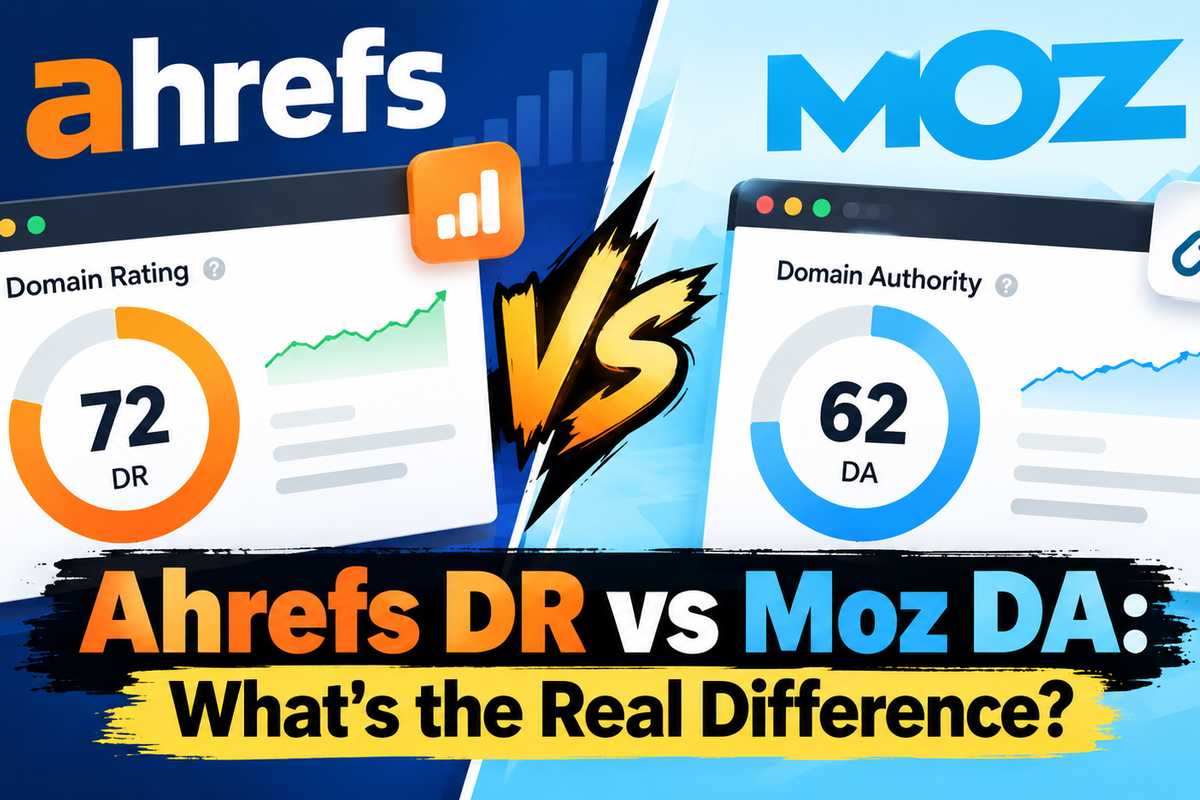

Ahrefs dr vs moz da questions come up constantly. Honestly, the confusion makes sense. Both scores run 0 to 100. They both claim to measure authority. Both get treated like gospel by people who’ve never checked how they’re actually calculated. Moz da vs ahrefs dr sounds like it should have a clean answer. It doesn’t.
Here’s the thing: these are two different companies measuring two different link graphs. Each uses its own formula. Ahrefs dr same as moz da? Not even close, and that’s fine. They were never meant to match in the first place.
A lot of people chase these numbers instead of fixing the stuff that actually moves rankings. If you haven’t already, the everyday mistakes that quietly wreck a site’s SEO matter more than any single authority score. A perfect DR won’t save a site with thin content or broken internal linking.
What Ahrefs DR actually measures
Domain Rating looks at your site’s backlink profile on a logarithmic scale. Higher DR generally means more, and better, sites linking to you. That’s the whole idea. How does ahrefs dr compare to da? DR is Ahrefs’ own creation. DA belongs to Moz. Neither one talks to the other’s index, and neither one crawls the exact same slice of the web.
Google has been direct about this too. One detailed look at the ranking-factor question confirmed that authority scores like these sit outside Google’s actual algorithm. Domain Rating falls into that same category. Both are third-party estimates. Useful for comparing sites side by side. Not something Google consults directly when ranking a page.
A site like Forbes shows why the number still matters anyway. Ahrefs forbes.com pulls up a DR near the top of the scale. That score comes from decades of links built up across major news outlets. This kind of authority takes years to build. It’s not something a brand new site fakes its way into overnight. No amount of link-building budget shortcuts that timeline. A small site trying to compete against a domain like that on DR alone is fighting the wrong battle entirely.
What Moz DA actually measures
Domain Authority works similarly to DR, just built on Moz’s own crawl data. Page Authority is the page-level version, and this is where people get tangled up. Did pa change with ahrefs da change confuses two completely separate systems. Ahrefs doesn’t even have a metric called DA. That naming mix-up shows up constantly in search queries. Usually it comes from people assuming Ahrefs and Moz share the same terminology. They don’t, and mixing them up leads to some genuinely confused link-building decisions.
PA moving on Moz has nothing to do with anything happening inside Ahrefs. Track each platform’s numbers separately. Otherwise the whole comparison stops making sense, and you end up chasing a change that never actually happened.
URL Rating vs Domain Rating
Url rating vs domain rating for ahrefs is a more useful pairing than DR vs DA. Both metrics live inside the same tool, which makes the comparison fair. DR measures your whole domain. UR measures one specific page. Ahrefs difference between ur and dr comes down to scope, plain and simple.
A homepage might carry a high UR from strong internal linking alone. The domain’s overall DR could still sit lower if the rest of the site is thin. This pairing matters more day to day than chasing DA parity with a competitor site. If you’re deciding which page deserves a big content push, UR tells you more than DR ever will.
It’s worth checking how these numbers stack up elsewhere too. A broader look at how the major SEO platforms compare shows DR is just one piece of a bigger report. Site Explorer alone surfaces a dozen other metrics worth understanding. Referring domains, organic keywords, and estimated traffic all sit right next to DR. Honestly, some of those tell you more about a site’s real strength than the authority score ever does.
How to actually check these numbers
How to see dr comparison in ahrefs is simpler than people expect. Site Explorer shows DR right at the top once you drop in a domain. Comparing two sites means running the same search twice. Then just write the numbers down side by side, nothing fancier than that.
A quick aside worth mentioning: moz keyword explorer use organic keywords is a completely separate feature. That’s about keyword research, not authority scores. Worth knowing so you don’t go hunting for DA data inside the wrong tab. And if you’ve ever typed ahrefs vs mox into a search bar, that’s just a typo for Moz. Happens more than you’d think when you’re typing fast and autocorrect isn’t paying attention.
My take
Neither score deserves the weight people give it. One small business guide on the subject put it plainly: authority scores predict ranking potential, they don’t guarantee it. I check DR and DA occasionally, mostly to gauge how a prospect site compares before a link pitch. I don’t obsess over moving my own number by a point or two every month. Clients ask about it sometimes, and I explain the same thing every time: it’s a snapshot, not a scoreboard.
Build good content, earn real links, and the number follows on its own. Chasing the score directly usually means chasing the wrong thing. It’s an easy trap to fall into. A client wants hard proof of progress every month. A rising DR feels like the easiest number to point to in a report. Even when it says very little about actual traffic or conversions, it’s an easy story to tell in a monthly update.
For what it’s worth, I check DR more often than DA these days. Not because it’s more accurate, just because it’s the tool already open on my screen most of the day. If you’re already paying for Ahrefs, DR is right there. If Moz is your main platform, DA works just as well as a directional signal. Pick whichever tool you’re already in, and stop trying to translate one score into the other’s scale. That conversion never works cleanly anyway, and trying to force it just wastes time you could spend on actual link building.