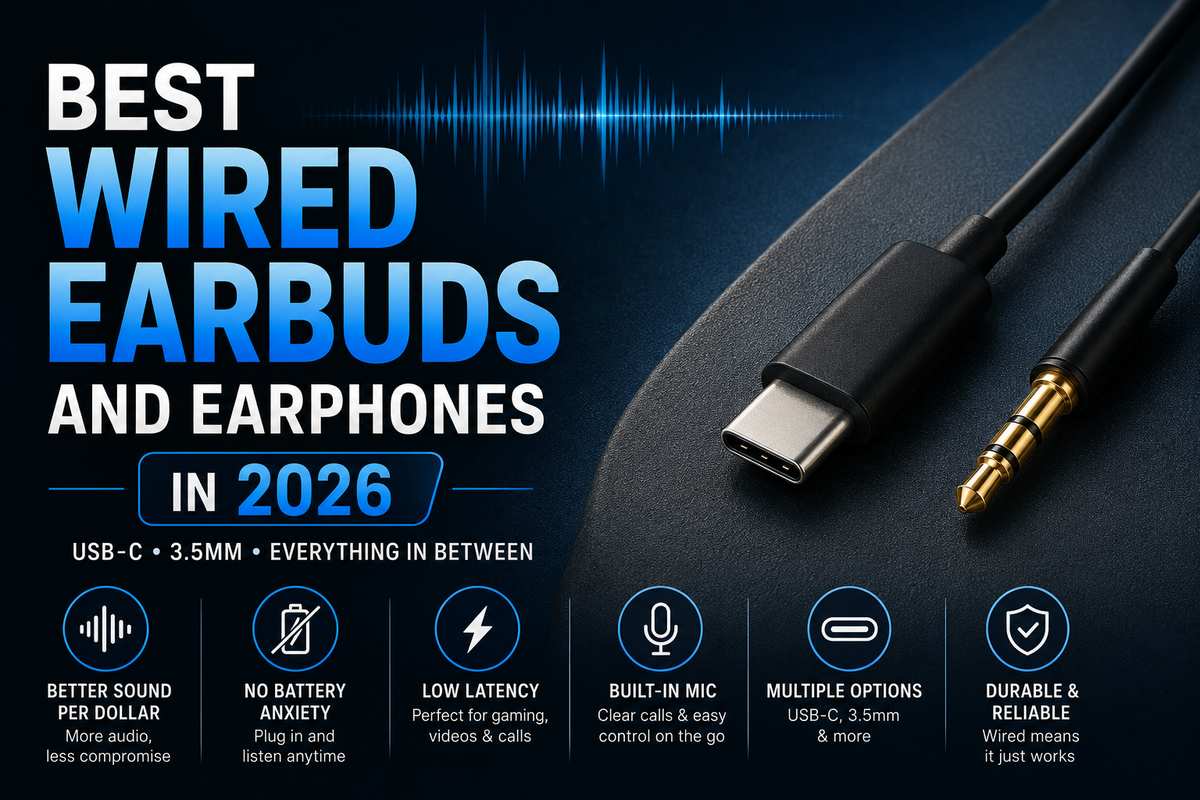

Here’s the thing, wired earbuds never actually died. They just got quieter about it while everyone else was busy buying AirPods. But the searches never stopped, and honestly the category’s had a bit of a comeback this year, partly nostalgia, partly people getting tired of charging yet another device. So if you’re after the best wired earbuds or best wired earphones for 2026, here’s my honest rundown, USB-C, 3.5mm, and everything in between.
Quick note before we start: “wired” now mostly means USB-C, not the old 3.5mm jack, since most phones dropped the headphone port years ago. I’ll flag which connector each pick uses.
Why Wired Still Makes Sense in 2026
There’s no denying wireless earbuds are more convenient day to day. But wired ear buds solve a few specific problems wireless still struggles with.
No battery anxiety. You’ll never open your case to a dead pair mid-commute. Lower latency, which matters if you’re gaming or watching anything where lip-sync drift is annoying. And it usually sounds better per dollar, since the manufacturer isn’t paying for Bluetooth chips, batteries, or charging cases, that budget goes straight into drivers instead.
The trade-off is obvious: a cable. If that’s a dealbreaker for you, fair enough, this probably isn’t the guide you’re looking for. If it’s not, stick around.
Best Overall: Apple EarPods (USB-C)
Honestly, if you’re just looking for something that works and works well, this is probably your safest bet among top wired earbuds. Apple’s USB-C EarPods aren’t flashy, but they nail comfort and call quality, which is what most people actually use wired earbuds for daily.
They’re not going to blow you away with bass or detail, that’s not really the point of these. What they do well is fit almost everyone comfortably right out of the box, though if standard tips never quite seal for you, my guide to earbuds for small ears covers better-fitting alternatives.
Best for iPhone: USB-C or Lightning Adapter Options
This one really comes down to which iPhone you actually own. Got an iPhone 15 or newer? You’re set, any USB-C wired earbuds will just plug in and work. Older Lightning models need an adapter dongle, which is a minor annoyance but not a dealbreaker.
Want something that actually sounds better than the stock EarPods? Look for a pair with its own DAC built into the USB-C plug itself, instead of leaning on whatever audio processing your phone does internally. Sounds like a minor spec on paper, but it’s the kind of difference you actually notice the first time you listen.
Best USB-C Wired Earbuds for Android
For Android users, usb c wired earbuds are now the default, not the exception. Samsung’s AKG-tuned bundled earbuds remain a strong pick if you’re on a Galaxy phone, but third-party options often out-perform them on sound.
If you’re comparing best wired earbuds usb-c options generally, prioritize ones with in-line volume and playback controls that are actually compatible with your phone’s OS. Some cheaper sets only support basic play/pause and nothing else.
Best Wired Earbuds with Mic for Calls
Not every pick is optimized for calls, so if calls matter, check specifically. The best wired earbuds with mic options should have the microphone positioned close to your mouth on the cable, not buried in the earpiece itself, since that placement picks up voice more cleanly.
Wired earbuds with a mic or wired earbuds with microphone listings on most retail sites don’t actually test call clarity, they just confirm a mic exists. I’d trust hands-on reviews over spec sheets here. A dedicated in-line remote with a call button also just makes daily use easier.
Best Wired Noise Cancelling: Shure SE425 Pro (3.5mm)
Wired ANC is a real thing, and I know that surprises people. Shure’s SE425 Pro is the one I keep coming back to if you want actual noise cancelling without going wireless at all. Worth knowing upfront: this one runs on a standard 3.5mm connector with a detachable cable, not USB-C, so factor that in if you’ve already committed to a USB-C-only setup. The passive isolation from the deep-insertion tips alone blocks a surprising amount of noise before any active cancellation kicks in.
This is the pair I’d point people to first, full stop. Yes, it costs more than a plain, passive, wired set, no argument there. But if you’re commuting daily, that isolation earns its price back pretty fast.
Best Budget Pick: Skullcandy Set (USB-C)
For anyone chasing cheap wired earbuds or best cheap wired earbuds, Skullcandy’s Set line delivers more than the price suggests. Under $50, and the fit is genuinely comfortable for extended listening.
Among corded earbuds and corded earphones in this price bracket, this is the one I’d actually recommend instead of just tolerating. Nobody’s calling these audiophile-grade, and that’s fine, they were never trying to be. For everyday use, they just do the job.
Best for Gaming: Low-Latency Wired Picks
For gaming specifically, latency beats almost every other spec on the sheet. Wired just skips Bluetooth’s delay entirely, and that’s exactly why a lot of competitive players still won’t touch wireless, no matter how much it’s improved over the years.
The good ones tend to favor a flatter, more detailed sound over boosted bass, since you actually want to hear footsteps and cues clearly, not have them drowned out. Most also come with an in-line mic for voice chat. If you’re putting together a PC or console setup and haven’t bought a dedicated gaming headset yet, honestly, start here first.
Best Over-Ear Alternative: Sennheiser IE 900 (3.5mm / 4.4mm)
If you’d rather go over-ear than in-ear, best wired over ear headphones and best over ear wired headphones searches usually lead people toward audiophile-tier gear like the Sennheiser IE 900. Like most gear in this tier, it ships with a detachable 3.5mm cable (a 4.4mm balanced cable is also available), not USB-C, since audiophile IEMs generally stick with the analog connectors serious listeners already have amps and DACs for. It’s a serious investment, but the detail retrieval and soundstage are in a different league from anything wireless offers at a similar price.
This one’s really for the audio nerds, the people who can actually hear the gap between “good” and “reference-grade.” If that’s not you, save your money.
Frequently Asked Questions
Honestly, both have their place, it’s not really a wired-versus-wireless fight. Wireless wins on convenience, and wired usually wins on latency and price-to-performance. Neither is objectively “better”; it depends on what you’re doing with them.
Yes, as long as you get USB-C wired earbuds (or a Lightning adapter for older iPhones). Most current wired options are already built for this.
Depends on what you’re plugging into. Most current phones dropped the 3.5mm jack entirely, so USB-C is the practical default for daily use. But if you’ve got a laptop, mixer, amp, or older device with a standard headphone jack, 3.5mm headphones still make sense, and a lot of higher-end wired earbuds and IEMs stick with 3.5mm (sometimes with a 4.4mm balanced option) since that’s what serious listeners already have gear for.
Often, yes, at the same price point, since wireless has to spend part of the budget on batteries and Bluetooth hardware. That gap narrows the more you spend on either side though.
If you’d rather skip the cable entirely, I also put together a full breakdown of the best noise-cancelling earbuds worth buying this year.