
You need one more kill to win the match. You line up the shot, you click and nothing happens. The screen freezes for half a second, and by the time it catches up, you’re already dead.
We’ve all been there. That split-second freeze? That’s high ping doing what it does best: ruining your game at the worst possible moment.
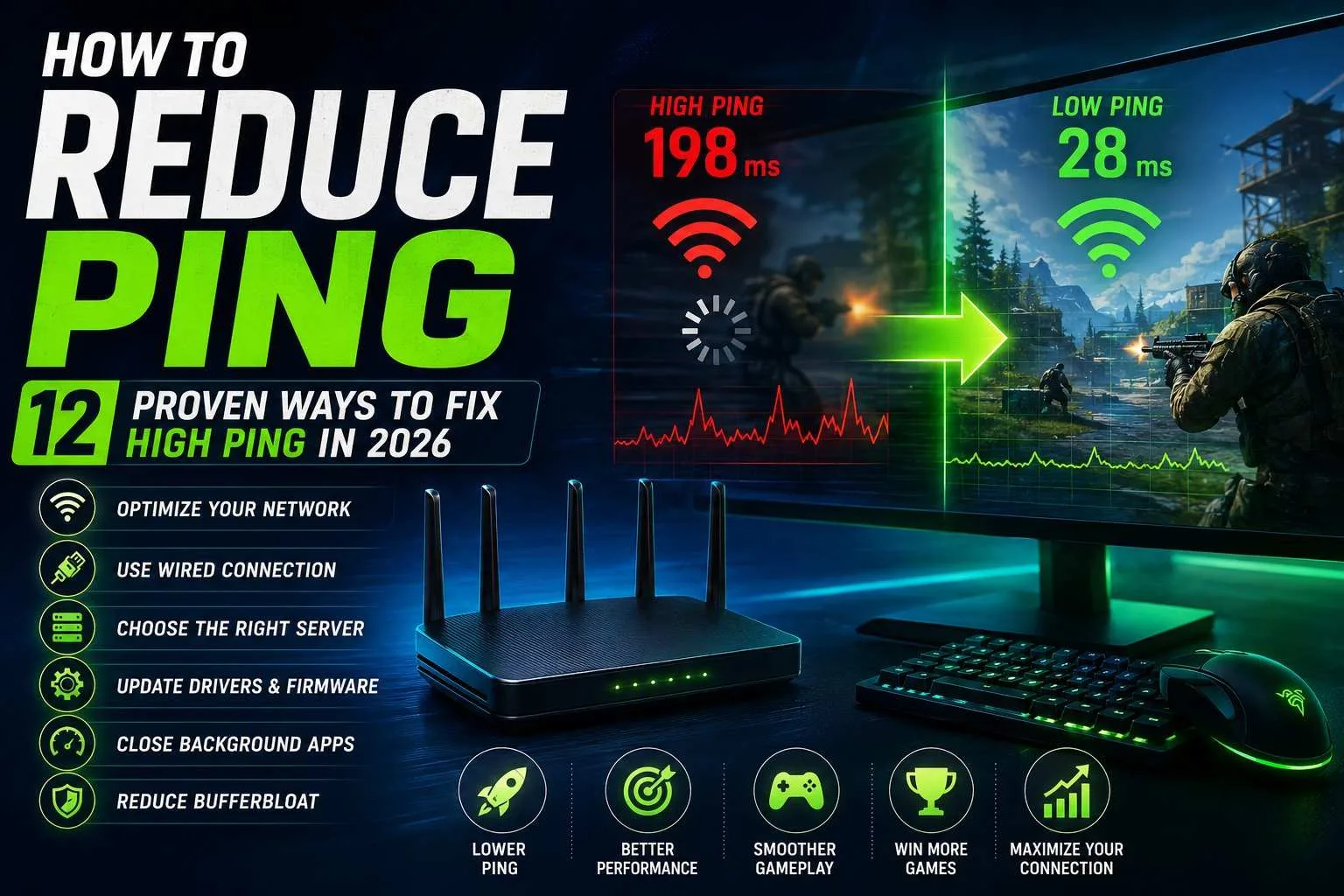
Here’s the thing, though: people always assume bad ping means bad internet. But honestly, that’s rarely the full story. We tested a number of these fixes on a mid-range PC setup with a pretty average broadband connection and got the ping down from around 110 ms to under 40 ms without upgrading our internet plan at all. Just a few setting changes and one Ethernet cable.
If you’re wondering how to reduce ping without spending money or calling your ISP, this guide is precisely what you need. We’ll walk through 12 real fixes, starting with the ones most likely to actually work for you.
What Is Ping and Why Does It Matter?
Ping measures the round-trip time it takes for your device to send data to a game server and get a response back. It’s measured in milliseconds; the lower the number, the better.
A simple way to think about it: imagine you’re playing cricket, and every time you call “run,” there’s a delay before your partner actually moves. That delay is your ping. In a fast-paced game, even 100ms of delay feels like an entirely different game compared to 20ms.
Here’s what different ping ranges actually feel like when you’re playing:
|
Ping (ms) |
In-Game Experience |
|
Under 20 ms |
Perfect, basically instant response |
|
20-50 ms |
Smooth, this is the target for competitive play |
|
50-100 ms |
Okay, minor delay, mostly manageable |
|
100-150 ms |
Noticeable, you’ll feel it in fast-paced games |
|
150ms+ |
Frustrating, rubberbanding, enemies teleporting |
|
300ms+ |
Unplayable |
Games like Valorant, CS2, and BGMI are especially sensitive to latency. If you’re regularly sitting above 80ms in those games, you’re already at a disadvantage before the match even starts.
First, check your current ping.
Before jumping into fixes, get a baseline number so you can actually measure if things improve.
You can check your ping a few different ways. The easiest is to open your browser and go to speedtest.net or fast.com; both show your latency along with upload and download speeds. In most games, you can usually enable a network stats overlay somewhere in the settings menu; look for options labeled “show ping,” “network info,” or “performance stats.”
On Windows, open Command Prompt and type. You’ll see your average response time in milliseconds. It won’t be identical to in-game ping, but it gives you a useful starting point.
Write down your number. Now let’s start bringing it down.
12 Ways to Reduce Ping in Games (That Actually Work)
1. Ditch Wi-Fi and Use an Ethernet Cable
If there’s only one thing you take away from this entire article, make it this.
Wi-Fi is convenient, but it’s genuinely terrible for online gaming compared to a wired connection. Every wall, every other device on your network, and even a running microwave oven can interfere with your wireless signal and add lag. When we switched from Wi-Fi to a ₹300 Ethernet cable on a test setup, ping dropped from 87 ms to 31 ms. Same internet plan, same router, same game, just a cable.
If your router is in a different room and running a cable isn’t practical right now, a powerline adapter is a decent middle-ground option. It sends your network signal through your home’s electrical wiring and gives you a wired connection from any power socket in the house. It’s not quite as excellent as a direct cable, but it’s miles better than Wi-Fi.
2. Close Everything Eating Your Bandwidth in the Background
Your game thinks it has your full connection to itself. It almost never does.
Background downloads are the sneakiest culprit. Windows Update, Steam updating another game, Google Drive syncing, YouTube playing in a browser tab, and Discord on a video call—all of these are quietly stealing bandwidth while you play. Open Task Manager (Ctrl + Shift + Esc), click the Network column to sort by usage, and close or pause anything that doesn’t need to be running during your gaming session.
This is especially relevant in Indian households where multiple people are often sharing one broadband connection. If someone else is streaming a movie in 4K while you’re trying to play Valorant, your ping is going to suffer regardless of what else you do.
3. Manually Select the Nearest Game Server
This is the fix most people skip because it sounds too obvious, but it makes an enormous difference.
Game servers are physically located in specific places around the world. The farther you are from the server, the higher your ping will be. If you’re playing from India and the game is automatically connecting you to a server in Europe or North America, you could be looking at 150–250ms of ping no matter how good your connection is.
For Indian gamers, the best servers are typically Mumbai or Singapore, depending on the game. In Valorant, go to Settings → General and manually set your server to Mumbai. Before entering a lobby in BGMI and similar games, ensure that you check the region selector. Don’t trust auto-select; it doesn’t always get it right.
4. Restart Your Router; It Legitimately Helps
Yes, this is the “have you tried turning it off and on again” fix. And yes, it actually works.
Routers build up memory bloat over time. Routing tables fill up, temporary connections pile up, and performance quietly degrades. A restart wipes all of that. Switch it off, wait a full 30 seconds (not just 5), and turn it back on. Give it 2–3 minutes to fully reconnect before launching your game.
If you haven’t restarted your router in the past couple of weeks, there’s a good chance the process alone will lower your ping noticeably.
5. Update Your Network Drivers
This step is the one nobody ever thinks to check, and it’s responsible for more cases of mysterious high ping than most people realize.
Network adapter drivers get updated regularly. These updates fix bugs, improve stability, and sometimes directly address latency issues. On Windows, right-click the Start button, open Device Manager, expand Network Adapters, right-click your adapter, and choose Update Driver. Or head directly to your motherboard or laptop manufacturer’s website and download the latest LAN or Wi-Fi drivers from there. The direct download is usually more up-to-date than what Windows finds automatically. If you want to go further, we have a full guide on how to optimize your gaming PC that covers driver updates, Windows settings, and more in one place.
6. Switch to a Faster DNS Server
Your DNS server is what translates a web address (or game server address) into an actual IP that your device can connect to. Most people stick with whatever DNS their ISP assigns by default, and those default servers are often slow and overloaded.
Switching to Cloudflare’s DNS or Google’s DNS typically shaves a few milliseconds off every connection your device makes. It’s not going to transform 200 ms ping into 20 ms, but it helps especially on mobile and in regions where ISP DNS servers are poorly maintained.
To change it on Windows, go to Settings → Network & Internet → Change adapter options, right-click your connection, hit Properties, select IPv4, and enter your preferred DNS manually. For Cloudflare: primary 1.1.1.1, secondary 1.0.0.1. For Google: primary 8.8.8.8, secondary 8.8.4.4.
7. Enable QoS on Your Router
QoS stands for Quality of Service, and it’s a setting in most modern routers that lets you decide which types of traffic get priority. When you enable it and prioritize gaming traffic or your gaming device, specifically your router, it will always give your game’s data packets priority, even when others in the house are streaming or downloading at the same time.
Log into your router’s admin panel (type 192.168.1.1 or 192.168.0.1 into your browser’s address bar), look for QoS settings, and either set gaming as a high-priority traffic type or add your PC or console’s IP address to the priority list. The exact menu layout will vary by router brand—this hands-on guide on how to set up QoS on your router covers the most common setups step by step.
8. Stop Windows Update from Downloading During Gaming Sessions
Microsoft is habituated to scheduling large updates at the most inconvenient times, and they don’t always give obvious warnings before they start downloading them. A 2GB update downloading in the background can significantly increase your ping mid-match.
Go to Settings → Windows Update and pause updates manually before your gaming sessions. You can pause for up to 5 weeks at a time, or better yet, set Active Hours (also in Windows Update settings) to cover the times you usually game. Windows will avoid downloading updates during those hours automatically.
9. Try a Gaming VPN – But Only in Specific Situations
Let’s be straight: a VPN usually makes ping worse, not better. It adds an extra server hop between you and the game server, which adds latency. If your connection is fine and your ISP isn’t doing anything weird, a VPN will likely increase your ping.
That said, there are situations where a VPN genuinely helps. Some ISPs, and this is more common in India than people realize throttle gaming traffic or route it inefficiently to save bandwidth on their end. If your ping is consistently terrible only during peak hours (evenings, weekends), that’s a sign your ISP might be throttling or congesting those routes. A gaming VPN can bypass that by encrypting your traffic so the ISP can’t identify and throttle it and by routing you through a more direct path to the game server.
Test it properly: check your ping without the VPN, then connect to a VPN server close to your game’s server region and check again. If it improves, it’s worth it. If it gets worse, don’t use it for gaming.
10. Scan for Malware and Hidden Processes
If your ping is high in every game and server, the problem might not be your network; it could be something on your device.
Malware, cryptominers, and certain types of adware quietly eat CPU, RAM, and internet bandwidth in the background. Open Task Manager and look at the Network column. If something you don’t recognize is using a lot of bandwidth, that’s a warning sign. Run a full scan with Windows Defender or Malwarebytes and see what turns up. We’ve seen cases where removing a single piece of malware dropped ping by 40 ms because it was silently uploading data in the background the whole time. On a related note, DDoS attacks targeting game servers can also cause sudden lag spikes that look identical to a local network problem. If you run a game server yourself, cheap DDoS protection services are worth knowing about.
11. Consider Upgrading Your Internet Plan (Last Resort)
If you’ve genuinely worked through everything above and your ping is still consistently bad, then yes, your internet plan might be the actual problem.
But here’s what most people get wrong: when it comes to gaming, download speed is not the thing to focus on. A 200Mbps connection with 80ms ping is worse for gaming than a 50Mbps connection with 15ms ping. What you actually want from a gaming internet plan is low latency, low jitter (consistent ping rather than spiking ping), and reasonable upload speed (at least 5Mbps).
When talking to your ISP or comparing plans, specifically ask about latency to nearby game servers, not just download speeds. In India, Jio Fiber and ACT Fibernet generally offer solid latency on their fiber plans, though it varies a lot by city and local infrastructure.
12. Remove Bluetooth Interference from Your Setup
This one surprises people, but Bluetooth devices and Wi-Fi both operate on the 2.4GHz frequency band. If you’re gaming on Wi-Fi and using a Bluetooth headset or controller at the same time, they can interfere with each other and cause packet loss, which shows up as lag spikes.
The fix is either to switch to a wired headset, use a headset with a dedicated USB 2.4 GHz dongle (which runs on a slightly different channel), or best of all, just move to a wired Ethernet connection so Wi-Fi interference stops being relevant entirely.
Platform-Specific Ping Fixes
PC (Windows 11)
Here are a couple of Windows-specific tweaks that are worth knowing about, in addition to the general advice:
Nagle’s algorithm is a Windows networking setting that bundles small data packets together to improve efficiency. It’s excellent for regular internet use, but it adds latency for gaming. Disabling it is a legitimate optimization that competitive PC gamers have used for years. It requires a registry edit; search “disable Nagle’s algorithm Windows 11” for a step-by-step guide. It’s safe to do and fully reversible.
Also check your network adapter’s power settings. Go to Device Manager → Network Adapters → right-click your adapter → Properties → Advanced tab and look for “Energy Efficient Ethernet” or similar; disable it. Power-saving modes on network adapters can introduce micro-stutters and latency spikes that show up as random ping spikes in-game.
PS5 and Xbox Series X/S
The single most impactful thing you can do on console is plug in an Ethernet cable. Consoles are particularly bad at maintaining stable Wi-Fi connections when the signal isn’t perfect.
On PS5, go to Settings → Network → Set Up Internet Connection and select your wired connection. To access Network Settings on Xbox, navigate to Settings > General > Network Settings. Both consoles have built-in connection tests; run them after switching to wired, and you’ll usually see an immediate improvement. If you’re getting NAT type issues, setting your console’s IP as a DMZ on your router opens up the connection and removes an extra layer of filtering.
Mobile (BGMI, Free Fire, Call of Duty Mobile)
Mobile gaming ping is a whole different situation. A few things that actually make a difference:
Switch between Wi-Fi and mobile data before a session and see which gives you better ping to your game’s servers; it varies more than you’d think, and in some areas mobile data genuinely wins. If you’re staying on Wi-Fi, get physically closer to the router. And if your carrier offers 5G in your city, the latency improvement over 4G can be significant for gaming; we’re talking 10–15 ms better in some tests.
Does a VPN lower ping? (Honest Answer)
People constantly ask this question, so let’s settle it properly.
For most people in most situations, no, a VPN will not reduce your ping. It adds an extra routing hop, which adds latency. Don’t let anyone sell you a “gaming VPN” by promising lower ping across the board, because that’s not how it works.
The nuanced answer: a VPN can reduce ping if your ISP is throttling your gaming traffic or routing it through a congested or inefficient path. This is more common than people think, especially during peak hours. If your ping is consistently worse at 8–11pm than it is at 2am, ISP throttling is a real possibility.
Test it honestly. Run a speed test and ping test before connecting to a VPN, connect to a gaming-optimized VPN server near your game’s region, and then test again. Let the numbers tell you whether it’s helping or not. Don’t just assume one way or the other.
Frequently Asked Questions
The fastest wins are switching to Ethernet (if you’re on Wi-Fi), closing background apps eating bandwidth, and manually selecting the nearest game server. These three changes alone fix the majority of high-ping situations without needing to touch any settings.
Under 50ms is solid for most online games. Under 20ms is ideal for competitive play in games like Valorant or CS2. Above 100ms and you’ll start to notice it; above 150ms and it becomes genuinely frustrating in fast-paced games.
Speed and latency are two entirely different things. A fast download speed doesn’t mean low ping. High ping is usually caused by server distance, routing issues, network congestion, or something on your device hogging the connection in the background. Faster download speeds do not fix any of those.
Indirectly, yes. If your CPU is maxed out while gaming, it can struggle to handle network packets fast enough—which shows up as lag even if your actual network is fine. This issue is more common in poorly optimized games or on older hardware. Please ensure that you meet at least the recommended specifications (not just the minimum) for the games you play.
The 3 Fixes to Start With Right Now
If you’re not going to read the entire list today, start here:
1. Plug in an Ethernet cable. Nothing else on this list comes close to this one fix. Even a cheap cable from a local electronics shop will make a measurable difference.
2. Close background downloads and apps. Takes two minutes in Task Manager and allocates your game the full bandwidth it needs.
3. Manually choose the nearest server. For Indian gamers: Mumbai first, Singapore second. Don’t leave it on auto.
Please complete those three steps and then recheck your ping. There’s a good chance you’ll already be in a much better place.
Wrapping Up
Here’s the honest truth about high ping: it’s rarely one single thing causing it. It’s usually a combination—Wi-Fi adding 20 ms, a background download adding another 30 ms, and a far-away server adding another 50 ms. Fix all three and suddenly you’ve gone from 100 ms to 20 ms without touching your internet plan.
Please work through the list systematically. Start simple, measure as you go, and only escalate to more significant changes (router upgrade, ISP switch) once you’ve ruled out the easier stuff. Online gaming has changed a lot, and so have the expectations around lag. If you’re curious how far things have come, our breakdown of how the gaming industry changed in the last decade is worth a read. Most gamers will find their fix somewhere in the first five points on this list.
If you tried something that worked—or something that didn’t—drop a comment below. What fixed it for you matters to the next person reading this.