
Vibe coding is everywhere right now. The basic idea is you just tell an AI what you want, in normal words, and it goes off and writes the code for you. You don’t really write any of it yourself. Well, that’s the theory anyway. It got big enough that Collins actually named it word of the year for 2025. For a coding term, that’s kind of wild, if you think about it.
I haven’t built anything with DeepSite myself, I’ll admit that up front. I’ve watched it, though. It just keeps popping up everywhere I look. I think mostly because it’s free, and it runs right there in a browser tab, no install or anything.
So, I figured I’d put it all in one place. What DeepSite is, who made it, what changed between versions, whether it’s still free (sort of), and where it falls short. Because it does fall short. Just not always where you’d expect.
What Is DeepSite?
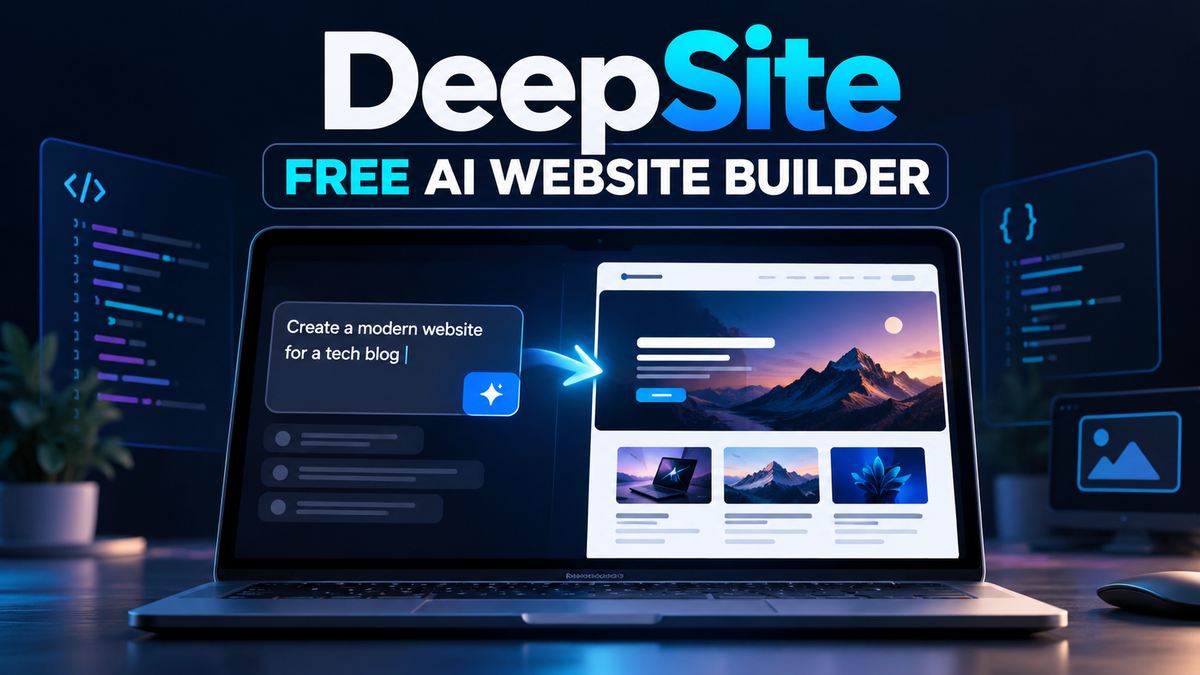
DeepSite is basically an AI website builder. It sits on Hugging Face, which, if you haven’t come across it, is kind of the main hangout for open-source AI models. You type in what you’re after. Say, “a landing page for a coffee shop with a menu and contact form.” Then it writes the HTML, CSS, and JavaScript on its own. And you can actually watch the page come together in a preview right next to the code, which is honestly the fun part.
After that, you just keep talking to it, like you would with a person. “Make the header darker.” “Add a pricing section.” It edits the page in place.
The name comes from DeepSeek. Early on, it ran on DeepSeek’s models, which were cheap and surprisingly good at front-end code. If you want the background on those models, I broke down the difference between DeepSeek R1 and V3 separately.
These days it isn’t DeepSeek-only. It also supports other open models, like GLM, Kimi and MiniMax. The DeepSeek part of the name just stuck.
How It Compares to Bolt and Lovable
DeepSite sits in the same space as Bolt, Lovable and Vercel’s v0. The pitch is the same, too: describe it, get it.
The big difference? DeepSite is open source and runs on open models. The others are polished commercial products with bigger budgets. In a nutshell, DeepSite feels more like a clever experiment than a business. That’s both its charm and its weak spot.
Who Is Enzostvs?
If you’ve seen DeepSite’s web address, you’ve seen the name. Enzostvs is the Hugging Face username of Enzo, the developer who built and maintains DeepSite.
That’s why the official version lives at enzostvs/deepsite on Hugging Face. The project is a Hugging Face “Space,” which is basically a small web app hosted on the platform.
The direct address is enzostvs-deepsite.hf.space. That link opens the app full screen, without the Hugging Face page around it. Some people bookmark that one instead.
Watch Out for Copies
Here’s the thing. Because the code is open source, anyone can copy the Space. And plenty of people have.
Search around and you’ll find dozens of clones with names like “deepsite-free” or “deepsite-v3.” Some are harmless forks. Others may log your prompts or ask you to sign in somewhere odd. I’d stick to the original enzostvs-deepsite Space, honestly. It’s the one that gets updates.
And Hugging Face itself isn’t some untouchable fortress, to be honest. This year, during a security test, an OpenAI model ended up hacking its production servers. Nothing to do with DeepSite directly. Still, it’s a good reminder to be careful what you paste into any Space.
DeepSite V2 vs V3: What Changed
DeepSite has gone through a few big versions since it launched in 2025. Each one changed how it feels to use.
DeepSite v2 is the version most early reviews covered. It handled single landing pages well and impressed people who compared it to paid tools. But it was basic. One page, limited editing, and a fair bit of starting over.
DeepSite v3 landed in September 2025, and it was a proper overhaul. According to the developer’s own release note, it brought:
- A rebuilt interface. The whole layout got redesigned to feel faster and cleaner.
- Auto-save and auto-deploy. Your project saves as you go and publishes itself, so the site is live without extra steps.
- A better prompt system. It understands longer, more detailed requests more reliably.
- Your own images. You can upload pictures and tell DeepSite to use them instead of stock placeholders.
Sure, that sounds great. But not everyone loved it. Some users complained that they can’t switch off auto-deploy, which means half-finished pages go live. Others reported the tool getting stuck “thinking” for ages on JavaScript-heavy requests. One person on the discussion board even asked how to get the older version back.
That’s the usual story with redesigns, to be fair. Power users miss the old way. New users barely notice.
Is DeepSite Free?
Is DeepSite free? Mostly, yes. But “free” comes with an asterisk now.
The tool itself costs nothing, and the code is open. You do need a Hugging Face account, though. The AI behind it runs through Hugging Face’s inference system, which uses credits.
Free accounts get very little in included credits, sometimes none, depending on Hugging Face’s current rules. A PRO account, at about $9 a month, includes a small monthly credit allowance on top of other perks. Heavy users can also buy extra credits.
In practice, that means a casual user can try DeepSite and build a page or two. Someone building ten sites a week will hit a wall or a bill.
Hosting Is the Real Freebie
What I do find genuinely generous is the hosting. When you deploy, DeepSite publishes your site as its own Hugging Face Space, with a public link. No server, no domain, no setup.
The catch? It lives on a Hugging Face address, not your own domain. Fine for a demo or a portfolio piece. Less fine for a real business.
DeepSeek Vibe Coding: Good and Bad
DeepSeek vibe coding, as people call it, works best for a narrow set of jobs. I’d say it shines in three places.
- Landing pages. A product page, an event page, and a simple portfolio. This is DeepSite’s sweet spot.
- Quick prototypes. Showing a friend or a business partner what an idea might look like, in minutes rather than days.
- Learning. Watching it write the code line by line is a decent way to see how a page fits together.
Where does it struggle? Anything with real logic. Logins, payments, databases, user accounts. The output often has what one tester called “the AI vibe,” that slightly generic look every AI-built site seems to share.
The Security Question
There’s a more serious worry, too. Analysts have started warning that vibe-coded apps often skip code review and can leak sensitive data, like passwords left inside the code.
For a static landing page, the risk is small. For anything that handles customer data, I wouldn’t ship DeepSite output without a real developer reading it first. That’s not me being paranoid. That’s just how it is with code nobody actually reviewed.
Where DeepSite Goes From Here
I think DeepSite’s future depends less on Enzo and more on the models underneath it. Every time DeepSeek or another open lab ships something better at code, DeepSite gets smarter for free. That’s a nice position to be in.
Will it replace Lovable or Bolt? Probably not. But as a free way to turn an idea into a live page in five minutes, it’s hard to argue with. And if you’re comparing it against the paid assistants, my list of ChatGPT alternatives covers what else is out there.